Happy World Soil Day!

Above are some of the World Soil Day logos available in different languages on the FAO website.

December 5th is World Soil Day! It’s a great opportunity to reflect on the importance of soils – to agronomists, of course, but also to the whole Earth.

Iowans are proud of our state’s soils in all of their diversity. Did you know that Iowa’s soils include Mollisols, Alfisols, Inceptisols, Entisols, and Histosols?  In our learning and teaching about soils at ISU, we recognize and honor soils as the “living skin of the earth,” where minerals, water, the atmosphere, and a host of organisms collaborate to sustain life.

Today we celebrate not only Iowa’s soils, but we also reflect on the magnificent diversity of soils around the globe. “Red and yellow, black and white, they are all precious in our sight!”

Please take a few minutes to check out the FAO’s World Soil Day website (Campaign Materials | World Soil Day, 5 December | Food and Agriculture Organization of the United Nations at fao.org), where you can find social media cards, educational posters about soil and water, as well as comics and videos about soils. They will brighten your day and broaden your appreciation for the global significance of soils to the health of our planet.

Key Messages for World Soil Day 2023

  • Soils provide the foundation for terrestrial ecosystem functions, environmental health, and human well-being.
  • Healthy soils are tightly interconnected with the storage of carbon, nutrient cycling, water quality, and water availability.
  • Soil management affects soil health, and thus the land’s capacity to withstand extreme climate events such as droughts, floods, and sand/dust storms.
  • Recognizing that we work with soils as integral partners for life on Earth, we must take proactive measures to protect them for future generations.


The logos above and in additional languages can be found on the FAO website.

By Bradley Miller, Michael Thompson, and Mary Tiedeman, ISU Agronomy

New Innovation and Entrepreneurship Faculty Fellows cohort announced

Innovation and Entrepreneurship Faculty Fellows cohort 2024

Projects using artificial intelligence to solve agricultural problems, cultivating Iowa’s wild yeast, and enhancing a food product development class are just a sampling of what faculty will be working on this coming year.

A group of 11 faculty representing eight departments in the College of Agriculture and Life Sciences at Iowa State University have been selected to participate in the 2024 Innovation and Entrepreneurship Faculty Fellows program. Each of the faculty will receive funding to support their proposed projects.

Established in 2022, the Innovation and Entrepreneurship Faculty Fellows program aims to foster and expand a culture of innovation and entrepreneurship among CALS faculty. It was initiated by the Dean’s Office for Academic Innovation and Start Something CALS. Nine faculty were part of the inaugural cohort, made possible by funding from CALS Dean Daniel J. Robison and President Wendy Wintersteen.

Carmen Bain, CALS associate dean for academic innovation, said there was a strong response this year from departments across CALS to apply for the program.

“The committee was impressed with the quality and range of proposals, all intended to enhance efforts to engage undergraduate students in innovative and entrepreneurial thinking and doing, which will better prepare them to be problem solvers of the future,” Bain said.

A common theme among projects is the effort to engage students in more interdisciplinary collaboration and engagement. The faculty also will seek to engage students with external stakeholders, including commodity groups, industry and non-governmental organizations, and K-12 students.

Additional information about the program and links to stories about the 2022 cohort’s projects can be found on the CALS Innovation and Entrepreneurship Faculty Fellows webpage.

Meet the 2024 IEFF cohort

  • Erica Beirman, teaching professor of food science and human nutrition, “Culinary Boot Camp for College Students – Fueling a Healthier Future”
  • Steven Bell, teaching professor of agricultural and biosystems engineering, “Transforming TSM 214 and TSM 397 to include Entrepreneurial Mindset with industry connections”
  • Elnaz Ebrahimi, assistant teaching professor of agronomy, “Advancing Undergraduate Education through Smart Agriculture: Introducing Smart Rhizobox Facility”
  • Kate Gilbert, associate professor of teaching of food science and human nutrition, “Enhancing FSHN 412 Food Product Development through Innovation and Ideation”
  • Dior Kelley, assistant professor of genetics, development and cell biology, “Curator of Art-Science”
  • Dawn Koltes, assistant professor of animal science, “Providing a Well-rounded Egg-cellent Education”
  • Jelena Kraft, assistant teaching professor of genetics, development and cell biology, “Building Bridges: Connecting genetics teaching laboratory data to classroom analysis”
  • Scott Nelson, associate professor of biochemistry, biophysics and molecular biology, “Cultivating Iowa’s Wild Yeast: Fostering Innovation in Iowa’s Craft Brewing Industry”
  • Joshua Peschel, associate professor of agricultural and biosystems engineering, “Generative AI to Solve Problems in Agriculture”
  • Timothy Stewart, associate professor of natural resource ecology and management, “Field Ecology Teaching: A course enabling students to gain professional skills while engaging children in scientific exploration”
  • Catherine Swoboda, associate teaching professor of global resource systems/horticulture, “Leading for Innovation”


Above photo: Innovation and Entrepreneurship Faculty Fellows Cohort 2024

By Whitney Baxter, CALS

ISU Crops Team Brings Home National Collegiate Crops Contests Awards

The ISU Crops Team from left: Elizabeth Tranel, Tyler Atkinson, Courtney Harle, and Aidan Bobholz with some of their awards.

The Iowa State Crops Team participated in the National Collegiate Crops contests the week before Thanksgiving and returned with a number of awards. Team competitors included Tyler Atkinson, Aidan Bobholz and Courtney Harle with Elizabeth Tranel participating as an alternate. Assistant Coaches Caitlyn Bruntz and Alex Coughlin were instrumental to the team’s success and traveled with the team as well.  Highlights include second place team overall wins at both the Kansas City and Chicago contests and all three individuals placed in the top 10 overall at both contests.

The team put up big numbers including All-American status (95% and above) for Courtney Harle overall all at both contests and six All-American awards across both contests for all three team members. In addition to the competition, the team participated in industry tours at Bartlett, American Royal, Bayer, John Deere, and the Farm on Ogden. Thank you to the Iowa Crop Improvement Association for sponsoring the team, which allows the group to travel to the contests. After a short break, the team is looking forward to preparing for the spring contests. For a full list of awards, click here.

In photo at top: The ISU Crops Team from left: Elizabeth Tranel, Tyler Atkinson, Courtney Harle, and Aidan Bobholz with some of their awards.

Gruss Named Forage Specialist with ISU Extension and Outreach

Shelby Gruss

Shelby Gruss has joined Iowa State University as an assistant professor of agronomy and Extension and Outreach state forage specialist.

Gruss will help educate Iowans about the value of forage production and address issues related to forage management, pests and diseases.

She grew up on her family’s row crop farm in northeast Indiana and earned her undergraduate and master’s degrees from the University of Illinois at Urbana-Champaign. Gruss earned her Ph.D. in plant breeding and genetics from Purdue University in 2021 and completed her post doctorate at Michigan State last year.

“I look forward to helping Iowa farmers utilize forages in the best way that they can,” she said. “There are so many different species that are classified as forages, and so many uses for forages, so no day will ever look the same.”

Gruss also has teaching and research duties and said she looks forward to the many interactions she will have across campus and out in the field. She will work closely with the extension crops team and also the extension livestock specialists.

“I see forages playing a role in almost any type of farming system,” she said. “They can help build soil health, help reduce soil erosion, and help with water quality, and they’re a feed source for livestock.”

Josh Michel, field agronomist with ISU Extension and Outreach, said he’s pleased to welcome Gruss as she fills an important role for Iowa producers.

“As the state forage extension specialist, she will be able to collaborate with field specialists across the state to deliver forage-related programs and content to farmers and producers. This is something that field specialists have been looking forward to for quite some time and we’re very eager to work with her,” said Michel. “Her diverse background and experience will be extremely valuable as she begins to identify priority areas in forages across the state.”

While she has a passion for forages, Gruss is also an accomplished wheelchair basketball athlete, having played for the University of Illinois and the U.S. Women’s National Team.

She is currently the athlete representative for the U.S. Paralympic women’s basketball team, and is an avid fan of basketball in general.

She can be reached at sgruss@iastate.edu or 515-294-1360.

Student organization contributes 2 tons of produce to SHOP

Good Earth Student Farm volunteers pose for a photo at the ISU Horticulture Research Station north of Ames. The group grows and harvests crops from beneath two high tunnels at the station.

How does one measure the impact of 2 tons of fruits and vegetables? Through the hands-on experience Iowa State University students gain during the planting, growing and harvesting process? Or by the number of smiles on students’ faces, knowing they can use some fresh fruits and vegetables to prepare their meals.

A student kneeling and planting a vegetable inside a high tunnel garden.
Some of the crops are planted and grown inside a high tunnel at the ISU Horticulture Research Station.

For the past two years, Good Earth Student Farm has been donating various fruits and vegetables grown by its student members to SHOP (Students Helping Our Peers), Iowa State’s on-campus food pantry. The donated produce has amounted to 4,000 pounds, or 2 tons.

The produce is grown beneath two high tunnels – one covered, one not – at the ISU Horticulture Research Station north of Ames. Everything from broccoli to lettuce to peppers is grown, including foods that would appeal to international students on campus – okra, sweet potatoes and Swiss chard.

Much of the produce starts from seeds germinated in the Department of Agronomy greenhouses before being transplanted to the soil beneath the high tunnels. The seeds are either donated or purchased using funds the Good Earth Student Farm receives from the university or the ISU Foundation.

“It was surprising to come back after spring break last semester and see the amazing transformation of how much the plants had grown,” said Laura Hinojosa, junior in animal ecology.

Prior to the COVID-19 pandemic, Good Earth Student Farm was operated as a Community Supported Agriculture operation. Through this, Iowa State faculty, staff and students could purchase shares to receive a supply of fresh, seasonal fruits and vegetables throughout the growing season. These shares were separate from the horticulture station’s regular produce operation.

Now, the organization operates as a workshare under the guidance of advisors Ajay Nair, professor of horticulture, and Mary Wiedenhoeft, interim department chair and Morrill Professor of agronomy. Good Earth Student Farm members receive produce in exchange for their time volunteering to grow and harvest the fruits and vegetables. The rest of the produce is donated to SHOP.

Student kneels on the ground next to two large sweet potatoes that were grown at Good Earth Student Farm.
Sweet potatoes, such as the very large pair pictured, are among the many fruits and vegetables grown by Good Earth Student Farm members.

Sarah Schroeder, SHOP co-president and senior in food science and global resource systems, said the produce received from Good Earth Student Farm is always quickly taken by SHOP patrons.

“This partnership offers the SHOP and its patrons access through the summer and fall months to a diverse array of produce items, including mustard greens, Swiss chard, peppers, tomatillos and okra, which are often harder to find in the grocery stores in Ames,” Schroeder said.

In addition to receiving produce in exchange for their time, the student members also get to apply the skills learned in their classes on the farm.

“Seeing first-hand the things I’m learning about in class has been cool,” said Sara Marston, freshman in agronomy. “My favorite part about this experience was our potluck, where we got to enjoy the things we grew.”

Next year, Good Earth Student Farm will expand its operation to the new Alliant Energy Solar Farm at Iowa State University. Working alongside faculty researchers, the student organization will help determine which vegetables grow best under or near solar panels.

No matter where the produce is grown – at the Horticulture Research Station or under the solar panels – Schroeder hopes the donations keep coming in.

“We hope to continue to maintain and expand this partnership,” Schroeder said. “We have great respect for the work being done through the Good Earth Student Farm and the model under which they operate.”

In photo at top: Good Earth Student Farm volunteers pose for a photo at the ISU Horticulture Research Station north of Ames. The group grows and harvests crops from beneath two high tunnels at the station.

Article by Whitney Baxter, CALS

ISU researchers hunt for hard-to-spot genetic links to improve crop and livestock breeding

Corn flattened by a derecho in 2020.

When a hurricane-like derecho knocked down corn plants across Iowa in August 2020, it was devastating for farmers. But it also presented a natural experiment for an Iowa State University research team, which fanned out across flattened fields in the days after the storm to record how crops held up.

High winds caused widespread lodging, which happens when a corn plant’s stalk breaks or its roots fail to keep it upright. The genetic makeup of corn stalk strength is well-studied, but little research has looked at what makes roots more resistant to lodging. By analyzing post-derecho observations of their genotyped test plots, searching for hereditary causes of root lodging, Iowa State researchers identified 118 genes that may affect corn root stability.

“That storm was such a disaster, so it was exciting to be able to make some lemonade out of lemons,” said Patrick Schnable, Baker Professor in Agronomy and Iowa Corn Promotion Board Endowed Chair in Genetics.

The root lodging study is an example of how advanced statistical analysis can help mine the expanding volumes of data collected by crop and livestock breeders, hunting for hard-to-spot relationships between the genetic code and complex traits that matter. An interdisciplinary research team at Iowa State recently won a $1.1 million grant from the U.S. Department of Agriculture to probe existing data for previously unseen links between the genetic instructions carried by plants and animals (genomes) and their physiological characteristics (phenomes).

Genetics is the cornerstone of breeding, but genomes-to-phenomes research powered by innovative statistical analysis and modeling can provide deeper insight that will be essential to meeting future agricultural production needs, said Schnable, one of the project leads.

“There are enormous challenges facing the world in terms of food supply. Agriculture was invented in a world different than the one we’ll be facing in the coming decades,” he said.

Developing crops and livestock that are more resilient to diseases and changing weather conditions is complex and urgent, said distinguished professor of animal science Jack Dekkers, a co-investigator on the grant. Deeper data analysis can speed up adaptation efforts.

“Breeding progress comes faster when you have a better understanding of the genetic basis of the traits you’re trying to improve,” Dekkers said.

Statistical detective work

The statistical detective work of searching for associations between genomic and phenomic data sets often tangles with environmental variation and other confounding factors. In the study of the derecho-downed corn, which is not part of the new grant, researchers initially weren’t able to detect the genetic causes of root lodging. Statisticians only found the genes of interest after including in their models the condition of neighboring plants, which impacted the effects of the extreme winds, Schnable said.

Associate professors of statistics Vivekananda Roy and Somak Dutta analyzed the post-derecho corn data and are co-investigators on the new grant. Their models integrate multiple methods of scanning large data sets, account for numerous sources of variation and employ strategies for more efficient processing. Their approach is like knowing the Dewey Decimal System when you’re looking for a library book instead of searching shelf-by-shelf, Roy said.

“If you know how the books are arranged, that’s a lot better,” he said.

Six ISU research teams have been identified to participate in the three-year project, which is funded through the USDA’s National Institute of Food and Agriculture. Dekkers said his data on 4,500 feeder pigs who went through a disease challenge includes growth rates and daily feed and water intake as well as genotypes of 450,000 genetic markers across the genome. For half the subjects, he also has data on expression of about 14,000 genes in blood prior to the disease challenge.

“It takes sophisticated statistical tools to make sense of data this detailed,” he said.

Just the start

The new grant builds on the work of the Agricultural Genomes to Phenomes Initiative, a project led by a group of researchers at Iowa State and other institutions that includes Schnable and Dekkers. AG2PI’s aim was cultivating a genomes-to-phenomes community among crop and livestock researchers by distributing USDA seed grants and holding conferences, workshops and field days. That education and training will continue with the new grant. Techniques developed for the project will be shared with colleagues and incorporated into some Iowa State courses.

Project leaders hope this is just the beginning of an explosion in genomes-to-phenomes research in agriculture. It’s a cost-effective way of leveraging existing research to help farmers continue to feed the world.

“A lot of money has already been invested in creating these data sets. The analysis to extract more knowledge from the data is much less expensive,” Dekkers said.

Contacts

Patrick Schnable, Agronomy, schnable@iastate.edu, 515-294-0975

Jack Dekkers, Animal Science, jdekkers@iastate.edu, 515-294-7509

Dave Roepke, News Service, dcroepke@iastate.edu, 515-294-4845

In photo at top: A research team led by Pat Schnable, Baker Professor in Agronomy and Iowa Corn Promotion Board Endowed Chair in Genetics, studied corn at his research nursery near Ames after it was flattened by a derecho in 2020. Photo by Lisa Coffey.

2023 Tri-Societies Meeting Highlights

Tri-Societies Award Recipients

Iowa State agronomy faculty and undergraduate, graduate, and postdoctoral scholars attended the Tri-Societies meetings in St. Louis, Missouri in November. Students participated in poster presentations, competitions, and seminars with the meeting culminating with an awards banquet.


2023 Tri-Societies Awards and Fellows

(Pictured above)

Dr. Michael Thompson assumed duties as Soil Science Society of America (SSSA) President.

Dr. Asheesh “Danny” Singh was one of eight named as a Crop Science Society of America Fellow.

Yunjiao Zhu was recognized as an Outstanding Paper Award Winner for the Soil Science Society of America for a paper titled, “Continuous Situ Soil Nitrate Sensors: The Importance of High-Resolution Measurements Across Time and a Comparison with Salt Extraction-Based Methods” by Yunjiao Zhu, Yuncong Chen, Md. Azahar Ali, Liang Dong, Xinran Wang, Sotirios Archontoulis, James Schnable, and Michael Castellano. https://doi.org/10.1002/saj2.20226

Alejo Ruiz received the Nelson Yield-Limiting Factors Graduate Student Scholarship.


Poster Competitions

Ashlyn Rairdin
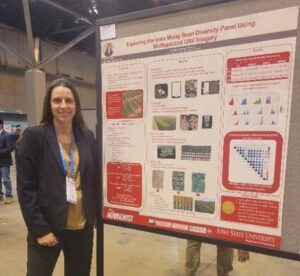
Ashlyn Rairdin placed 3rd in the C01-Graduate Student Poster Competition.

Several undergraduate and graduate students participated in poster competitions during the Tri-Societies meetings. Congratulations to, Ashlyn Rairdin, left, graduate student of Dr. Arti Singh, who placed 3rd in the C01-Graduate Student Poster Competition. 


Agronomy Club Attends Annual SASES Meeting

Agronomy Club

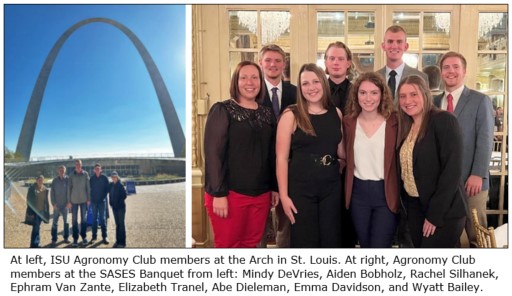
The Iowa State Agronomy Club took six members to the National Students of Agronomy, Soils, and Environmental Sciences (SASES) American Society of Agronomy International Annual Meeting at the end of October. The meeting this year occurred in St. Louis, Missouri where students explored a variety of keynotes, tours, and contests.

The Iowa State students who attended the meeting this year participated in Quiz Bowl achieving second place as a team made up of Wyatt Bailey, Abe Dieleman, Ephraim VanZante, and Rachel Silhanek and the Crops Judging Contest achieving fourth place as a team made up of Emma Davidson, Abe Dieleman, Ephraim VanZante, and Aidan Bobholz. Iowa State also had individuals competing. Elizabeth Tranel achieved third place in the Manuscript Contest, Rachel Silhanek participated in the Speech Contest, Aiden Bobholz presented a poster over research from on campus lab work, and Wyatt Bailey presented in the President’s Trophy Contest.

Congratulations to these individuals for their achievements and for representing Iowa State University and the Agronomy Club. The theme of this year’s meeting was “Open Science Inspires.”

Iowa State Leaders Champion Women’s Leadership in Ag and AI Technologies

Arti Singh, associate professor, agronomy (far left), speaking to students at Fellows Elementary School in Ames, with representatives of the new Iowa State University group, Women in Agriculture and Artificial Intelligence (WIAA). Image below: Iowa State graduate student Ashlyn Rairdin (center) with other members of WIAA demonstrating a drone to an elementary school group. Pictures by Venkata Naresh Boddepalli.

Artificial intelligence is the focus of many conversations as society tries to understand its uses and implications. Arti Singh is internationally recognized for her work exploring AI’s potential for agriculture, and she is encouraging other women to take leadership in AI technologies for the future.

Two years ago, Singh, a plant breeder and associate professor in Iowa State University’s Department of Agronomy, started to organize a new group of students as Women in Agriculture and Artificial Intelligence (WIAA) to encourage women to get more involved in AI and recognize its potential to solve diverse ag-related problems.

“Our goal is to inspire women in STEM disciplines who can lead, influence and create a better future for agriculture using AI tools,” Singh said.

Her growing cadre of AI enthusiasts, primarily led by graduate students, are off to an active start. They have conducted outreach events to agronomy classes at Iowa State, the Women in Ag club, and to 4-H youth leaders and members. They led a rover-building workshop at the Women in Science and Engineering (WiSE) Go Further Conference last spring.

At a STEM festival they organized for fourth- and fifth graders at Fellows Elementary School in Ames, they demonstrated several AI applications, such as how drones can be paired with AI for more accurate crop scouting to identify pests and diseases. They also showed students how computers can be trained to identify insects – the basis of a new bug identification tool Singh is developing with Mechanical Engineering Professor Baskar Ganapathysubramanian and others at Iowa State. Their AI-powered insect ID can quickly identify more than 2,500 insects. Soon to be released for public use, it aims to improve farmers’ ability to make effective pest management decisions.

Singh’s efforts to advance AI extend far beyond Iowa. Recently, during a trip to Germany to build international collaborations for AI applications in agriculture, she met women working in AI at PhenoRob, where she discussed ways to start a new international chapter of Women in Agriculture and AI. A few weeks later, she was in Washington, D.C., showcasing Iowa State’s new AI-based insect app at a National Science Foundation Day on Capitol Hill.

The WIAA group includes undergraduate and graduate students in the College of Agriculture and Life Sciences and the College of Engineering. One of the student leaders working with Singh to promote Women in Ag and AI is Ashlyn Rairdin, a doctoral student in agronomy. Rairdin coordinated the event at Fellows Elementary and helped Singh organize other WIAA outreach projects, including training for 4-H leaders. The idea of crop-scouting drones and robotic rovers were among the AI uses that originally attracted her interest to pursue a Ph. D. in Plant Breeding at ISU

Three women in red Iowa State shirts demonstrate a drone to an elementary school group.
Iowa State graduate student Ashlyn Rairdin (center) with other members of WIAA demonstrating a drone to an elementary school group.

“This is an area where women haven’t always had the most representation,” Rairdin said. “I like the idea of sharing the potential of these cool technologies with younger women and girls and encouraging them to think, ‘I could do that kind of work someday.’” Rairdin’s career goal is to work with AI in industry “to build bridges between agriculture, data science and engineers.” She sees opportunities to use AI especially for repetitive, time-consuming tasks that few want to do, allowing humans to focus on more complex, interesting jobs.

Currently, she is programming unmanned aerial vehicles to collect data for Singh’s mung bean research and advocating for the WIAA chapter to become an official student group. The chapter has grown to include about 20 students, including two undergraduates. “We are working to expand and involve more students,” she said. “Our hope is to structure the organization so we can have several outreach events each year and also emphasize mentoring for undergraduates to get them involved in this area of research.”

Watch the video to learn more about Women in Agriculture and Artificial Intelligence at Iowa State.

Contacts:

Arti Singh, Agronomy, 515-294-0948, arti@iastate.edu

Ashlyn Rardin, Agronomy, arairdin@iastate.edu

Ann Y. Robinson, College of Agriculture and Life Sciences Communications, 515-294-3066, ayr@iastate.edu

FFAR Features the Research of Drs. Lübberstedt and Aboobucker

Dr. Siddique Aboobucker

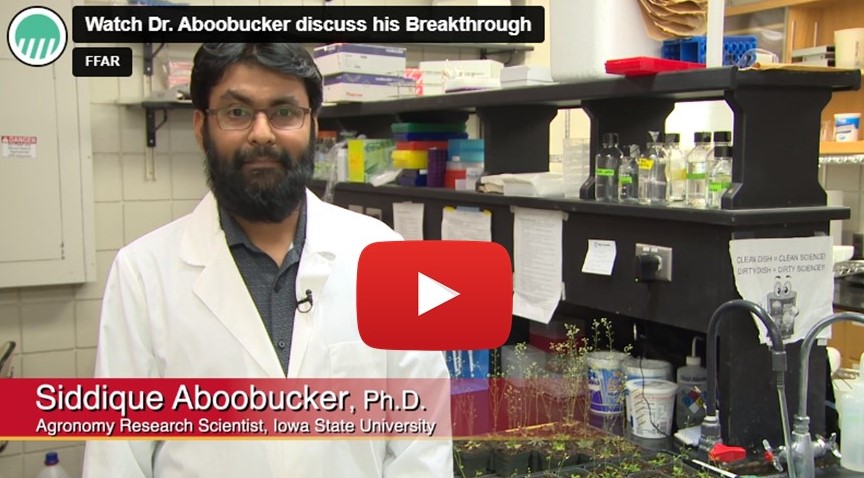
A “Breakthrough” story and video interview on research conducted by Drs. Thomas Lübberstedt and Siddique Aboobucker and graduate student Liming Zhou is featured on the Foundation for Food and Agriculture Research (FFAR) website. The research focused on “Accelerating Crop Development with Improved Haploid Fertility.”

Video of Siddique Aboobucker
Video of Dr. Siddique Aboobucker discussing research on “Accelerating Crop Development with Improved Haploid Fertility.”

According to the FFAR article, “Plant breeders and researchers are developing crops that can better withstand climate stresses, produce larger yield or contain higher levels of essential nutrients – but it takes plant breeders an average of 10 years to develop a new crop. New breeding tools like doubled haploid technology can speed up development of hybrid crops, which are created by crossbreeding varieties of plants to promote desired traits such as increased yield or pathogen resistance.

While studying accelerated plant breeding in a project funded in part by FFAR, Aboobucker uncovered a process that has significant potential to efficiently and cheaply restore fertility to male haploid plants. This breakthrough has major implications for crop breeding research and techniques. Next steps include trying this process with haploid corn varieties. By increasing the success of doubled haploid breeding and fertility, breeders will be able to provide growers with a larger number of crops created to promote more desired agricultural traits such as higher yield and increased resilience in a shorter time.”

To read the initial article on this research, visit the CALS website.


Photo at top: Dr. Siddique Aboobucker, research scientist in agronomy, holds a five-week-old haploid Arabidopsis ps mutant plant in flowering stage. The computer screen shows magnified images of a flower, stained on a microscopic slide. Anthers, male parts of the flower, look like mushrooms on the screen and pollen grains appear like tiny pearls. Photo by Whitney Baxter, Iowa State University.

Senior Embraces Agronomy Studies Through a Variety of Experiences

student Courtney Harle

Courtney Harle, a senior double majoring in agronomy and international agriculture from Kanawha, Iowa, has taken advantage of many opportunities during her time at Iowa State, making for a well-rounded experience.

Over the summer, she gained experience as a field biologist intern with BASF in Story City, Iowa. She assisted in small plot research for crop protection products from laying out trials across the farm to using a backpack sprayer to treat them. She also helped plan and execute many field days where she had the chance to network with internal employees from across many divisions, local co-op retail employees, and farmers. “I worked with a great team of people and loved getting to play a part in bringing new ag solutions to the market to serve farmers,” said Harle. Following graduation, Courtney plans to transition to a new role on the BASF Story City Research Farm to continue supporting the research and development of crop protection pesticides.

Last spring, she competed on the ISU Crops Judging Team. The team competed in two regional contests where she individually placed fourth in both. The team traveled to Modesto, California, for the 2023 North American Colleges and Teachers of Agriculture (NACTA) National Contest where she competed as an alternate for the team score and individually placed sixth overall. This fall, she continues to compete on the team for upcoming regional and national contests.

Harle has also completed two travel courses and is enrolled in a third. She traveled to the United Arab Emirates over the 2021 Thanksgiving break to explore their economic diversification and culture. During her fall 2022 semester, she traveled to Uruguay to study soils, agricultural field research, and livestock. This coming winter break, she will travel to Panama to learn about tropical agriculture and participate in the Panamanian New Year’s traditions. Harle said, “Traveling abroad has cultivated a love for experiencing life outside my comfort zone. A special thank you to the agronomy department for their support of international travel through the Fellowship Award!”

Currently, she serves as vice president of the Soil and Water Conservation Club and is a two-time recipient of the Elinor L. Fehr and Walter R. Fehr Endowed Scholarship and the Roland W. Holden Memorial Scholarship for the 2022 and 2023 school years.


Photos of Harle above from left: Preparing to spray a small plot herbicide trial during her BASF internship, with Dr. Lee Burras in Uruguay on a hike in Quebrada de los Cuervos National Park, in the United Arab Emirates visiting the Sheikh Zayed Grand Mosque.

Dr. Hornbuckle Invited to Present at NASA Jet Propulsion Laboratory

Dr. Hornbuckle
Brian Hornbuckle with Europa satellite.
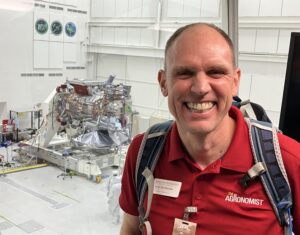
Hornbuckle on the viewing balcony of JPL’s Spacecraft Assembly Facility with NASA’s Europa Clipper satellite in the background. It will be going to Jupiter to study one of its moons, Europa, where it is hypothesized that there is a water ocean under layers of thick ice, which may also contain life.

On October 10-12, Dr. Brian Hornbuckle attended a workshop at the NASA Jet Propulsion Laboratory (JPL) in California. He was invited to talk about how new satellite measurements at a higher spatial resolution could be used to better understand ecosystems. Speaking on agro-ecosystems, the title of his presentation was “Besides Soil Moisture, What can be ‘Seen’ with Satellite L-band Radiometry in the U.S. Corn Belt?”

The goal of the workshop was to start the process for contributing to NASA’s 2027 Decadal Survey, which will be used to prioritize new Earth-remote-sensing satellite missions. Scientists in the community are providing input on science priorities that will be merged into a list of most important questions and needs. Workshop participants are putting together a list of new science that could be accomplished with measurements at 10-km resolution using microwave satellites rather than the current 40-km resolution. Information provided by Brian Hornbuckle.

Photo at top: Dr. Hornbuckle at NASA’s Jet Propulsion Laboratory.

ISU Agronomy Soil Judging Team Competes in Region V Soil Judging Contest

ISU Agronomy Soil Judging Team

Congratulations to the ISU Agronomy Soil Judging team on their success at the Region V Soil Judging Contest hosted by South Dakota State University and South Dakota NRCS employees. The competition was held the first week of October near Sturgis and Deadwood, South Dakota and was led by Dr. Amber Anderson and assistant coach Adam Subora, a graduate student in soil science. The team took fourth place during the competition. Members of the ISU team also placed third in the jumble judging competition and Molly Simmons placed ninth in individual competition.

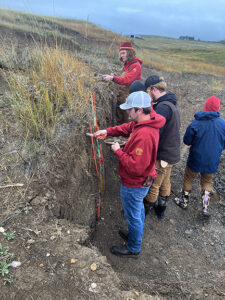
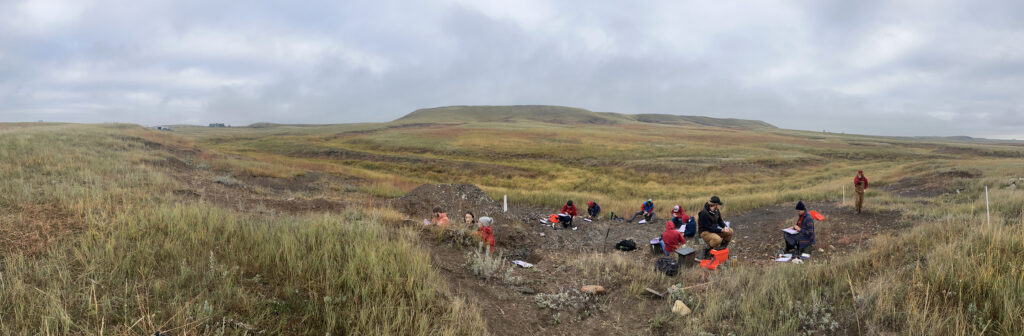
practice digThe event helps train students to describe, classify, and interpret soils both individually and as a team. Anderson explained, “Most of the week was spent learning about local soils and unique geography of Western South Dakota, which started with a geology tour of the badlands, continued through the example soil pits, discussion of major geologic formations and soil features of the area from the NRCS local and regional professionals.”

Alex Cecil, a senior in agronomy and mechanical engineering said, “The competition allowed us to see many different soils which we don’t get to see in Iowa, and it was a great way to learn.”

The team was one of 10 participating in the multiple-region contest, which included the University of Nebraska-Lincoln, University of Nebraska-Omaha, University of Minnesota, University of Missouri, Kansas State University, Iowa State University, and South Dakota State University from region 5, and Colorado State University, Utah State University, and University of Idaho from region 7.

Iowa State University will host the national contest in spring of 2024. Approximately 25 collegiate teams from across the country will compete. Photos and information provided by Amber Anderson.

In group photo at top: front row from left: Rebekah Veldboom, Elizabeth Severson, Estelle Venable, Molly Simmons, and Evelyn Bauer. Second row: Kai O’Connell, Gavin Anderson, Austin Elm, Tad Hatfield, and Amber Anderson. Third row: Adam
Subora (assistant coach), Nicolas Truitt, Alex Cecil.

South Dakota
The Region V Soil Judging Contest hosted by South Dakota State University was held near Sturgis and Deadwood, South Dakota