Emily Kihlstrom, a junior in agronomy, took part in a CALS travel course to India from December 29 to January 15. Participants were able to learn first-hand about India’s different crops (vegetables, coconut, banana, tea, coffee, rice, rubber, cashew, spices, pineapple, etc.) and production techniques. Students had the opportunity to visit regional vegetable, spice, and flower markets and interact with students at the Kerala Agricultural University.
Kihlstrom said she has always loved traveling and exploring new places. When she looked into study abroad courses, she knew India would be a one-of-a-kind trip and it was on her bucket list to visit.
One interesting thing Kihlstrom learned on the trip was that India’s major agricultural pests include wild boars and peacocks. “The tricky part of managing these animals is that farmers can’t easily kill them, since peacocks are the national bird of India and the boars are protected under India’s government. Some farmers can kill boars if they obtain a license to do so, but they can’t sell or eat the meat that comes from it,” said Kihlstrom.
Her favorite part of the experience was being immersed in a completely different culture. “From food to traditional dances, Kerala, India was a beautiful place to visit,” said Kihlstrom.
In photos above, clockwise from top left: Women sorting tea leaves by quality after harvest, in Munnar, Kerala, India. A performer for Kathakali, the traditional dance of Kerala at Kerala Kalamandalam, a school for traditional arts. Emily Kihlstrom with her Travel Class trying different varieties of bananas at the Banana Research Station, Kerala Agricultural University. A flower market in Tamil Nadu, India. Emily Kihlstrom in front of a tea plantation in Munnar, Kerala, India. Photos provided by Emily Kihlstrom.
Agronomy senior Courtney Harle said her travel study course to Panama “Tropical Agricultural Production International Business, and Trade in Panama” was a great way to finish up her second degree in international agriculture. The trip took place Dec. 29 through Jan. 10. “I chose to travel to Panama because I love crop production, and I wanted to be able to compare Iowa’s corn and soybeans to tropical agriculture like pineapple, cacao, coffee, bananas, and sugarcane,” said Harle.
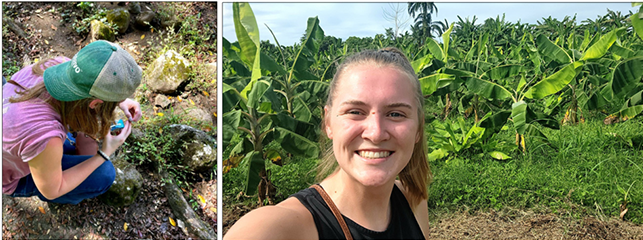
First photo at left, Harle checks out weeds and plant life. Second photo, Harle at a banana plantation.
She said a great stop on the trip was to La Granjerita (The Little Farmer), a woman-owned farm that grows a diverse selection of fruits and vegetables. “I learned that she uses basil to prep her greenhouses because it acts as a natural repellent for red spider mites to protect later high value crops. There is a huge push for organic production across Panama, so it was fascinating to see how different farmers were approaching their pest management strategies,” said Harle.
Her favorite part of the experience was engaging with the rich Panamanian culture. “We actually had the opportunity to “trade” cultural dances. They taught us the Tamborito, which is the national dance of the country, and we taught them the Copperhead Road line dance, said Harle.
In photo at top: From left, Raven Kinnetz, Courtney Harle and Dr. Ebby Luvaga, economics, learn about pineapple production in Panama. Photos provided by Courtney Harle.
Meyer Bohn and Bradley Miller released the LE-DSM for north central Iowa. This map is the next generation of digital soil maps designed to meet the needs of the digital agriculture revolution. The LE-DSM spatial database provides 10-m resolution predictions of soil organic matter, particle size fractions (clay, silt, sand %), and texture class at standard depth intervals 0-5, 5-15, 15-30, 30-60, 60-100, and 100-200 cm. The LE-DSM is more accurate than the Soil Survey Geographic (SSURGO) map (Bohn and Miller, 2024). This is an excellent resource for many soil data end users. For agroecosystem modelers, this means more accurate simulations and predictions. In addition, tech-savvy farmers can access this fine resolution data to optimize their land management practices, ultimately improving crop yield and sustainability. This new data is available at https://doi.org/10.25380/iastate.24871656.
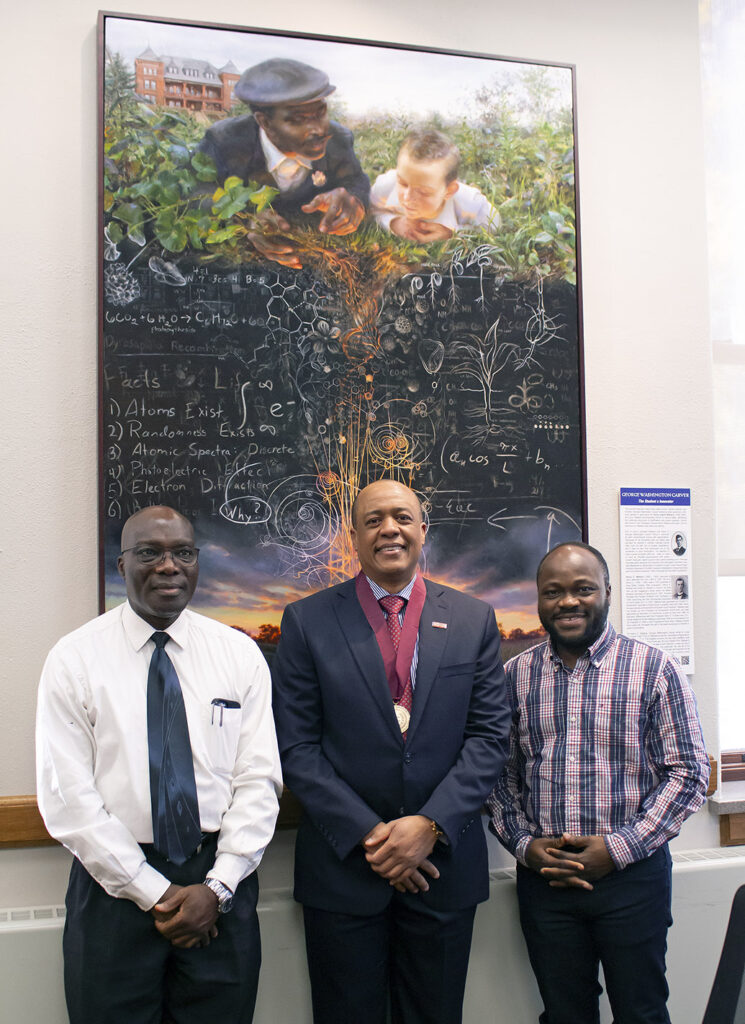
From left, David Kwaw-Mensah, Walter Suza and Boris Alladassi in front of a painting featuring Carver.
George Washington Carver Endowed Chair Walter Suza was honored with the GW Carver medallion during a celebration on January 31, which officially recognized him as the newest holder of the position. The celebration coincided with the recognition of GW Carver Day at Iowa State, which took place Feb. 1. Dr. Suza acknowledged his predecessor, Andrew Manu, calling him a “trailblazer” and by citing one of his favorite quotes from Carver, “How far you go in life depends on your being tender with the young, compassionate with the aged, sympathetic with the striving and tolerant of the weak and strong. Because someday in your life you will have been all of these.”
Suza spoke about his challenging childhood in Tanzania…walking at night to fetch water, walking two miles to attend school, hearing his mother talk about crops being decimated by insects and praying for rain. He would carry these experiences into adulthood and would be impacted further by the birth of his own children (not wanting them to face what he had faced) and during his work with UNICEF. He spoke of an experience while working as a food security specialist for UNICEF in which there was a severe drought in southern Zimbabwe. Tens of thousands of children under the age of five were in need of supplemental feeding and it was his job to determine which children would receive food supplementation.
Ultimately, this would lead to his goal of wanting to end world food insecurity, which took him into a career in plant breeding and in supporting the training of future plant breeders in Africa. His efforts, along with fellow peers involved in the PBA Program, would lead to training in more than 170 countries. “The need for agricultural development is about integrated interventions that are the heart of developing the next generation of leaders to make life better for their people,” said Suza. He went on to explain that food insecurity is not just a problem abroad, but also here in Iowa. According to Feeding America, “69,000 children in Iowa face hunger.”
Suza ended by saying, “I’m proud and honored to carry the George Washington Carver Chair name.” An article about his thoughts on the receiving the honor and in “Listening to George Washington Carver” can be found here.
Article by Kara Berg, Agronomy. Photos by Whitney Baxter, CALS
In top photo: Interim Agronomy Department Chair Mary Wiedenhoeft and CALS Dean Dan Robison, present Dr. Walter Suza (center) with the George Washington Carver medallion. Photos by Whitney Baxter
Efforts to breed more adaptable crops benefit from testing locations with wide ranges of weather, according to a research team led by an Iowa State University professor.
The recent study published in the Journal of Experimental Botany is the latest work by agronomy professor Jianming Yu exploring phenotypic plasticity, the disparate ways plants respond in different environments. Better understanding the genetic and environmental underpinnings of plasticity can help scientists and breeders create hybrids tailored for their location and able to adapt to challenging conditions.
“Our research really has broad implications for climate change, sustainability and precision agriculture,” said Yu, the Pioneer Distinguished Chair in Maize Breeding and director of the Raymond F. Baker Center for Plant Breeding.
To a certain degree, the study confirmed the Midwest is an ideal region for experimenting on new cultivars, thanks in part to its erratic weather, Yu said.
Jianming Yu
“Seed companies have breeding locations across the Corn Belt, and historically, we know some testing sites seem to be more successful and did not end up on the chopping block as companies have merged. There hasn’t been much actual research into that. It’s just been the assumption,” he said. “But if you want the most variability you can get, that’s a good place to be pulling data. Location matters.”
The study examined data from 174 rice plants grown in nine different combinations of sites and growing seasons across Asia from 2007 to 2009 and 237 sorghum plants in nine different site-and-season environments in Iowa, Kansas and Puerto Rico from 2011 to 2016. In prior analysis of the same data, including studies in 2018, 2020 and 2022, Yu and his colleagues looked for the environmental signals connected to plant traits. For example, the researchers established for both crops an environmental index that predicts flowering time, an analysis the new paper builds upon.
“This time we changed the focus to whether what you observe could depend on the specific examples you encounter in terms of environment,” Yu said.
By comparing small subsets of data to the overall sample, an analysis that incorporated many simulations, researchers found they could accurately extrapolate with four or more environments. But the environmental mean range, a gauge of the variability of the conditions, served as an even better indicator.
“While both factors are critical, our results indicated that considerations leading to an increase of environmental mean range should be given priority in study design,” said Tingting Guo, professor at Huazhong Agricultural University, a co-lead of the study.
Even two testing sites could offer accurate predictions, if their environmental conditions are diverse and extreme, the researchers found. Additional simulations based on historical weather records and varying planting dates were used to show the distributions of potential environmental variability for each site.
“This offers breeders some practical guidance for resource allocation and testing site optimization,” Yu said.
Yu said his research group will continue to study phenotypic plasticity, mostly by further scrutinizing existing field test results. He sees harnessing plasticity as essential to making agriculture more resilient in the face of climate change.
“We’re analyzing data in different ways and from different perspectives to generate knowledge that applies to real-world decision-making,” he said.
In top photo: Sorghum plants growing in August 2020 in a field at the Agricultural Engineering and Agronomy Research Farms between Boone and Ames. Photo by Jianming Yu
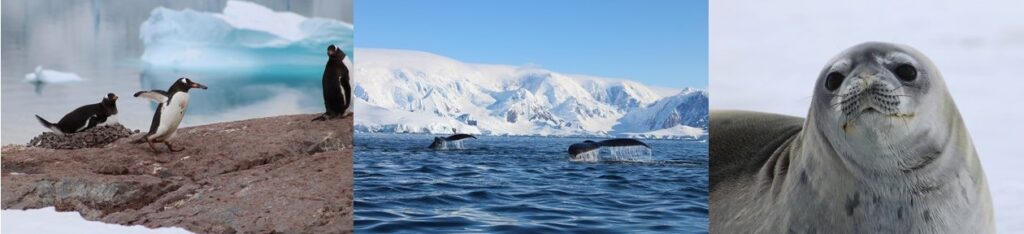
Agronomy seniors Sage Coffman and Gavin Anderson took a study course to Antarctica from January 2-January 16, which was led by Dr. Stephen Dinsmore and Dr. Julie Blanchong, Natural Resource Ecology and Management. The course titled “Natural History of Antarctica,” took students to Antarctica through Ushuaia, Tierra Del Fuego, Argentina. They spent 12 days on a ship exploring the Weddell Sea, Antarctic Peninsula and the South Shetland Islands. Expedition leaders and lecture staff guided students in viewing wildlife, which included whales, a variety of seabirds, penguins, and seals. Students explored the icebergs, mountains and waterways of Antarctica’s geography.
Coffman says he enjoys study abroad classes because they are interactive and feedback is immediate. “I learned a lot more than I would have expected from the birds and mammals in Antarctica. Antarctica is more diverse in life than I previously expected, with many different species of penguins, seals, and whales, plus plants and other birds. My favorite part of the trip was getting to climb a mountain in the snow on the continent of Antarctica with my fellow classmates to see and learn about some chinstrap penguins that live on a rocky mountain ridge. Learning in person and learning about the history, cultures, and languages is awesome, and making new friends is always a great experience,” said Coffman.
Scenery and wildlife from Antarctica. Photos by Sage Coffman
In photos at top: Sage Coffman with an iceberg in the background. Group from left: ISU CALS students Cameron McNally (Environmental Science), Gavin Anderson and Sage Coffman (agronomy). Photos provided by Sage Coffman.
A group of Iowa State University students recently returned from the “Tropical Agriculture and Culture in Ghana” study course to Ghana, Africa, which took place from December 30-January 15. Instructors Dr. David Kwaw-Mensah, agronomy, Dr. Theressa Cooper, agricultural education and studies and assistant dean for diversity for the College of Agriculture and Life Sciences, and CALS Global Programs Agricultural Education and Studies Director, Jodi Cornell accompanied the group. The students visited three ecological areas of Ghana including the dry coastal savannah, the semi deciduous rainforest, and the high-rain evergreen forest, where students learned about tropical agriculture, agroforestry, animal production, animal ecology, and aspects of Ghanaian culture in foods, art, and music. Students had the opportunity to interact with local farmers for community service.
Agronomy students Kylie McGlade, Chris Meyer and Emma Caspers went with the group. “We truly did it all, visiting local farms, research stations, cultural landmarks, and being immersed into local communities!” said McGlade, a senior in agronomy. “As an Agronomy major also studying genetics, it was extremely interesting to learn about breeding projects in different crops especially rice. Traveling and speaking to farmers and researchers in other countries is so eye opening as a way to learn from each other and further agronomic knowledge.”
One of the most exciting things Caspers learned about during the trip was the cultivation of Rubber Trees. “It fascinated me to discover that harvesting the sap from these trees requires years of experience, with precision being crucial in scraping the bark. A single mistake in the cut could negatively impact the tree’s ability to produce rubber sap,” said Caspers. The highlight of her study abroad experience came during her interaction with professors, farmers, and children. “Seeing the positive impact our presence had on their lives, despite the challenging weather conditions, was truly heartwarming. They warmly welcomed us and made sure we had the best possible experience during our time there. Everyone we met truly gave us the ‘Ghanian Kindness’ that my professor Dr. Kwaw-Mensah always spoke so highly of upfront,” said Caspers.
In photos at top, from left, agronomy senior Kylie McGlade takes a selfie with members of the Ghana study course group making their way by boat to the Village on Water (Nzulezo). Center, the group visits a demonstration rice plot at the Crops Research Institute, Kumasi. At right, (from left) Lydia Johnson, Dr. Theressa Cooper, and Kylie McGlade wear leaf hats while visiting Nzulezo. Villagers had given them the hats to cool down, but they are usually worn as umbrellas. Photos provided by Kylie McGlade.
The newly elected 2024 Undergraduate Agronomy Club officers are:
President: Jordan Lawless
Vice President: Tyler Atkinson
Recording Secretary: Emma Davidson
Treasurer: Ethan Reed
Historian: Rachel Silhanek
Corresponding Secretary: Aidan Bobholz
Program Coordinator: Jackson Mullenhoff
Sr. CALS Representative: Dale Lyons
Jr. CALS Representative: Ephraim Van Zante
Thank you to the retiring officers who graduated in the fall or will be graduating this spring: Wyatt Bailey, Josh Baudler, Cole Buckley, Alex Coughlin, Mattie Howell, Tom Thompson, and Elizabeth Tranel.
In photo: 2024 Undergraduate Agronomy Club officers front row from left: Rachel Silhanek, Emma, Davidson, Dale Lyons, and Tyler Atkinson. Back row from left: Jackson Mullenhoff, Jordan Lawless, Ethan Reed, Ephraim Van Zante and Aidan Bobholz.
Van der Laan and Di Salvo Named 2023 Outstanding Graduate Students
The Agronomy Graduate Student Club would like to recognize Liza Van der Laan and Juan I. Di Salvo for being awarded the 2023 Outstanding Graduate Student Award. This award recognizes one PhD and one MSc student within the department for their academic achievements, research progress, and leadership. Liza and Juan are examples of driven students who are very deserving of this award. Congratulations!
Liza is nearing the completion of her PhD in Plant Breeding. Her PhD project aims to leverage genomic and phenomic approaches to improve the climate resiliency to heat stress and seed composition traits in soybeans. With her PhD results, she has helped develop heat-tolerant soybean varieties. She is co-author of a book chapter and a review paper and is working as the lead author to complete two of her first PhD project papers this spring. Liza is enrolled in the Preparing Future Faculty Program and has extensively presented her research at national and international conferences. For the past two years, Liza has been the teaching assistant and later the co-instructor in a graduate-level plant-breeding course. She has served as the treasurer and vice president of the Agronomy Graduate Student Club and as Speaker Chair and co-chair of the committee organizing the R.F. Baker Plant Breeding Symposium.
Juan will complete his master’s degree in Plant Breeding this year. His research project focuses on characterizing Finger and Proso millets and the adaptation of these crops to Iowa growing conditions. Furthermore, he has led several activities for the soybean breeding program in 2022 and 2023. Juan is a co-author of a paper and has presented his results in several venues. Outside of his research projects and breeding program, Juan has served as secretary of the AGSC and was part of the committee organizing the 2023 R.F. Baker Plant Breeding Symposium.
In above photo: At left, Liza Van der Laan and at right, Juan Di Salvo, recipients of the 2023 Outstanding Agronomy Graduate Student Award.
AMES, Iowa — Asheesh “Danny” Singh, professor of agronomy with expertise in soybean breeding and phenomics at Iowa State University, has joined the Iowa Soybean Research Center (ISRC) as a co-director. He holds a courtesy appointment in the Department of Agricultural and Biosystems Engineering.
“Danny is the perfect person to join me in leading the ISRC,” said founding director Greg Tylka. “I look forward to working shoulder to shoulder with him to advance the center to greater heights and in new dimensions.”
Singh’s addition highlights the long-term commitment on the part of Iowa State University in its support of soybean research. With the addition of Singh, and in honor of the ISRC’s 10-year anniversary in July, the co-directors will work together to expand the research and educational activities of the center while maintaining a focus on soybean production research.
“Danny and Greg are a great team. They encourage research in all that they do, so it’s a very natural fit for these two to lead the ISRC into the next decade together,” said Associate Dean for Research and Discovery Carolyn Lawrence-Dill.
“I embrace this new role with humility and determination,” Singh said. “I look forward to working with Dr. Tylka, the Iowa Soybean Association, and industry partners to improve soybean production and profitability in a coordinated manner. I look forward to learning from the ISRC staff and helping foster increased collaboration among the ISRC-affiliated faculty members and their teams.”
“The Iowa Soybean Association looks forward to continuing our partnership with ISRC, building upon the successes of the past decade with Danny and Greg in this newly formed co-directorship,” said Iowa Soybean Association Chief Officer of Research and Conservation Christie Wiebbecke, who also serves as the ISRC’s Industry Advisory Council Chair.
Singh joined Iowa State University in 2013 as a faculty member in agronomy and has been an affiliate of the ISRC since its inception in 2014. He has published over 160 peer-reviewed papers, authored a textbook on plant breeding, and developed more than 70 varieties grown on more than 10 million acres annually. He has delivered 75 invited presentations nationally and internationally. He has received ISRC funding on two collaborative projects, one focused on soybean root and microbiome traits, and the second on the effects of increased CO2 and abiotic stress on soybeans.
In 2023, Singh was appointed G.F. Sprague Chair by Iowa State’s Department of Agronomy and named a Crop Science Society of America Fellow. He serves as an associate chair for Discovery and Research of the university’s Department of Agronomy and provides leadership to the Soynomics research group, which received the College of Agriculture and Life Sciences Team Award. In 2021, Singh received the ISU’s Mid-Career Achievement in Research Award and the department of Agronomy’s Raymond and Mary Baker Agronomic Excellence Award.
About the Iowa Soybean Research Center
The Iowa Soybean Research Center was established in 2014 by Iowa State University in partnership with the Iowa Soybean Association. The center was founded to increase soybean production and profitability for Iowa farmers through coordinated research efforts involving Iowa State, the Iowa Soybean Association and the private sector. Information on becoming an industry partner of the Iowa Soybean Research Center is available by contacting center director Greg Tylka, 515-294-0878, or ISRC@iastate.edu.
Above photo: From left, ISRC Co-directors Greg Tylka and Asheesh “Danny” Singh and Iowa Soybean Association’s Christie Wiebbecke, who serves as the ISRC’s Industry Advisory Council Chair.
An estimated 1,809 students completed their Iowa State University degrees this semester. That total included 224 masters, 94 doctoral students, and 1,491 bachelor’s degree recipients who were honored at Hilton Coliseum over the weekend. Below are the fall 2023 students who graduated from the Department of Agronomy.
Agronomy Senior Celebrated for High Academic Achievements
Erik Gerdts is the fall 2023 recipient of the College of Agriculture and Life Sciences Student Council Academic Achievement Award, which recognizes individuals who have earned high academic honors while at Iowa State University. Gerdts will be walking across the stage at convocation with a 3.99 GPA, summa cum laude and featured on five semesters of the Dean’s List. He is graduating with a major in agronomy, a minor in agricultural business and a certificate in soil science. Full article
Iowa State Online Agronomy Graduate Discovers Path to Success
In a journey of resilience and determination, Jordan Hauck, a new father, agronomist, and graduate, discovered a path to success through Iowa State University’s master’s in agronomy program. Hauck is a working adult student juggling the demands of fatherhood and a challenging career in agronomy. His story is a testament to the transformative power of flexible online education that offers the freedom to thrive in both personal and professional realms. Full article
In graphic at top of page, in top right photo from left: Michael Thompson, Ala Khaleel, and Marshall McDaniel at the graduate commencement ceremony. Photo in bottom right are some of the agronomy faculty, staff and students at the College of Agriculture and Life Sciences Convocation Ceremony. Photo in bottom left, from left: Yu-Ru Chen, Thomas Lübberstedt, Tyler Foster, and Tanner Cook at the graduate commencement ceremony.
More than 580 people attended the 34th Annual Integrated Crop Management (ICM) Conference at its new location at Prairie Meadows in Altoona on December 4 and 5, 2023. Producers, commodity organizations, industry, and researchers had the opportunity to attend 66 sessions that offered up the latest research and recommendations on crop management. Topics ranged from nitrogen and cover crops to a panel on the Endangered Species Act.
Speakers from agronomy and titles for their presentations included Mark Licht: It’s Not the Size of the Corn but How it Yields and Out of the Box Soybean Management; Antonio Mallarino: Agronomic, Economic, and Water Quality Implications of Different P and K Fertilization Management Concepts; Sotirios Archontoulis and master’s student Carolina Freitas: Changes to Corn Hybrids Over the Last 40 Years and What Do Deep Soil Moisture Measurements Tell Us About Water Stress in Iowa?; Michael Castellano, Melissa Miller and PhD student Mitchell Baum: Iowa Nitrogen Initiative: Overview, Recruiting and 2022-2023 Results; Rick Cruse: Soil erosion and Water Resource Management; and Richard Roth: Impacts of Cereal Rye on Nitrogen Cycling and Crop Production.
In photo above, top row from left, Sotirios Archontoulis, Mark Licht, and Michael Castellano. Center row from left, Antonio Mallarino, Richard Roth, Melissa Miller, and Rick Cruse. Bottom row from left, Meaghan Anderson, Mitchell Baum, and Carolina Freitas.