Iowa Nitrogen Initiative to bring more precision to fertilizer rates

Fayette County farm

When Michael Castellano tells people there are billions of different variations of farmer decisions and environmental conditions that can affect how much nitrogen fertilizer is just enough for a plot of corn, he’s occasionally chided for embellishing. Really? Billions?

“They’ll say, ‘Mike we get that it’s complex. You don’t need to exaggerate.’ But I’m not exaggerating. When you do the math, it’s literally billions of possible combinations of hybrid varieties, management practices, weather and other variables,” said Castellano, the William T. Frankenberger Professor of Soil Science and an Iowa State University professor of agronomy.

That uncertainty has big economic and environmental implications. Applying too little nitrogen hurts yields. Applying too much hurts profits because nitrogen is typically the most expensive input for corn production. Excess nitrogen in fields also contributes to water and air pollution.

Despite incentives to use just the right amount of nitrogen fertilizer on corn fields, current official recommendations are broad and ideal rates can vary widely from field to field and year to year. A research team led by Castellano and his ISU colleague Sotirios Archontoulis, Pioneer Hi-Bred Agronomy Professor, is collecting data from trials across Iowa – mostly in fields of participating volunteer farmers – to build models that offer far more granular guidance.

“This project is an investment that will help keep Iowa the best place in the world to grow corn and soybeans,” Castellano said.

The Iowa Nitrogen Initiative is supported with annual funding from the Iowa Department of Agriculture and Land Stewardship. Iowa Secretary of Agriculture Mike Naig said the nitrogen initiative is a strong collaboration between Iowa farmers and ISU experts.

“Farmers depend on the best science when making decisions about crop production, including nutrient management, crop inputs and conservation practices,” Naig said. “This important work will lead to data and tools that farmers will utilize to optimize nutrient management, boost profitability and protect our natural resources.”

Closing the gap

The Iowa Nitrogen Initiative is running 270 on-farm trials this year across 72 different private farming operations. That’s a 400% increase in trials from the project’s first year in 2022. The ultimate goal is 500 trials per year.

To participate, farmers need access to two increasingly common precision ag technologies: variable rate fertilizer application and GPS-based yield monitoring. Using historical yield data to choose spots expected to behave differently, project partner Premier Crop Systems designs a trial in a small area of a field, usually about five acres. Sections within the trial area are assigned varying nitrogen rates, from none up to 200 pounds per acre, and farmers provide the yield data to the research team after harvest. Participants are compensated for the loss of yield on land that receives no nitrogen.

Trial data is enriched with simulations from biophysical process models to calculate optimal rates based on soil and seed types, management practices and weather. That database will be the engine behind the project’s public-facing decision-making tools, which are expected to be ready to use for the 2025 growing season.

The tools will be especially valuable for farmers using the precision ag technology needed to collect the data. Farmers who have the equipment for applying fertilizer at a variable rate often have insufficient evidence-based direction on how those rates should vary, Castellano said.

“We’re trying to close the gap between the precision ag advances made by engineers and the scientific understanding of agronomists,” he said.

Three tools in the works

The research team plans to develop three decision-making tools:

  • Updated and more dynamic benchmark recommendations for nitrogen rates will account for differences in genetics, soil, management and weather. Farmers also will be able to see anonymized data from trials to see the real-world outcomes of various rates and practices.
  • Forecasting will estimate ideal rates based on current and near-term predictions for soil and weather conditions. That’s important because weather has a disproportionate impact on nitrogen rates, Castellano said.
  • Hindcasting will help farmers look back at a prior growing year to explore how their crop’s nitrogen needs would have changed if they’d done things differently, from planting a different hybrid to applying at a different time.

Castellano said the goal is to continually refresh the tools with new trial data every year.

“As long as farmers are innovating and the weather is changing, optimal nitrogen rates will be changing. We need ongoing research to provide farmers the information to make the best decisions possible,” he said.

Farmers in the fold

Farmers have been involved in the Iowa Nitrogen Initiative from the beginning, including a design sprint in February facilitated by Google engineers and designers. Feedback from farmers, for instance, is why the initial rollout of the decision-making tools will be a mobile app. They told project designers they’re more likely to use the information if they can access it on the go.
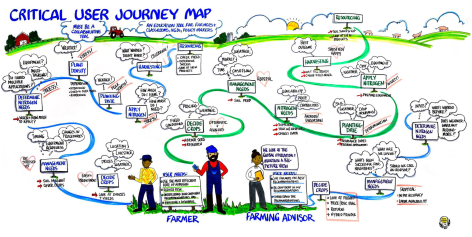
Design spring sketch
A sketch created during a Google-sponsored design sprint illustrates some of the needs farmers and crop advisors have as they consider nitrogen rates. Image courtesy of Iowa Nitrogen Initiative.

“We’ve been working hand in hand with farmers who have helped us make sure the products we’re developing are useful for the people who will use them,” Castellano said. “We don’t want farmers to feel this is forced on them.”

Castellano said he’s encouraged that every farmer who participated in the first year of the project continued in the second year. Roger Zylstra is one of those volunteers who has hosted two years of trials. At a field day in September at a university farm near Boone, he told the crowd that collaborating with the research team was as simple and seamless as could be, though he’s hoping for some wet years soon to provide more variations in the data.

“I always try to figure out how to be a better steward of the land, and we learn there are better way to do things,” said Zylstra, a former president of the Iowa Corn Growers Association who farms near Lynnville in Jasper County. “I think the potential here is amazing.”

Project leaders are recruiting farmers, crop advisers and custom fertilizer applicators to sign up for a trial in the 2024 growing season. Fill out an online form to express interest or seek more information.


In photo at top: Research aimed at providing Iowa farmers with far more precise recommendations for nitrogen fertilizer application rates relies on trials in fields across the state. At this Fayette County farm, the lighter-colored portions of the field are where little or no nitrogen was applied. Photo courtesy of Iowa Nitrogen Initiative. 

Agronomy Alum on a Mission to Make a Difference

ISU agronomy graduate Riley Wilgenbusch sits on a mountaintop in Peru.

This past spring, Riley Wilgenbusch, a 2020 ISU agronomy and global resource systems graduate, earned his Master’s in Public Health; International Health concentrated in Health Systems, from Johns Hopkins Bloomberg School of Public Health. Wilgenbusch calls his MSPH a good fit to meaningfully build upon his undergraduate studies in global resource systems at Iowa State. He also completed two graduate certificates at the Bloomberg School, one in humanitarian health and the second in food systems, the environment, and public health from the Johns Hopkins Center for a Livable Future complementing his undergraduate degree in agronomy.

ISU agronomy graduate Riley Wilgenbusch received his Master’s in Public Health from Johns Hopkins Bloomberg School of Public Health.

“Iowa State was a great opportunity for me to grow into where I am now. The Agronomy Department challenged me to think critically about our food production systems while other experiences across campus rounded out my perspectives on many issues including healthcare. Pursuing a degree and career in public health just felt like the right next step,” Wilgenbusch said of his time at Iowa State.

Wilgenbusch also has fond memories of his time at the Bloomberg School, “My two years carried me to Peru to study nutrition and food security in the wake of the Covid-19 pandemic, and deep into the legislative systems of Washington, D.C., which impact the way we live each and every day. I am so excited to carry out my mission of achieving a more sustainable, equitable world for all as I support research for this year’s farm bill.”

Wilgenbusch recently accepted a job at the Colorado Coalition for the Homeless in Denver, Colorado working on health service provisions for persons experiencing homelessness. He is developing a career in research and policy to leverage food and health systems to build global public health systems that are resilient, sustainable, and equitable.

While Wilgenbusch’s career path may not be the norm for an agronomy graduate, he says it also highlights one of the fascinating things about the field. “The food we grow is fundamental to how we live each and every day – all 8.1 billion of us. Food supports livelihoods and is deeply ingrained in my work addressing the root causes of poverty and improving quality of life for those experiencing poverty. Food, health, and housing are fundamental rights that go hand-in-hand and that is a universal truth that guides my career path forward from the Agronomy Department into the world.”

In photo at top, Riley Wilgenbusch sits on a mountaintop in Peru.

Roth to Serve as Assistant Professor of Agronomy and Extension Nitrogen Education Specialist

Richard Roth, Agronomy and Extension Nitrogen Education Specialist
AMES, Iowa – Richard Roth has joined Iowa State University’s Department of Agronomy and Extension and Outreach as a nitrogen science education specialist.

Roth started with the university on Sept. 18 and will serve as assistant professor in the Department of Agronomy at Iowa State, with an extension education appointment.

“I’m very proud to work for Iowa State and the opportunity to contribute to the Department of Agronomy,” said Roth. “In Iowa, nitrogen is a huge issue because our crops depend on it, and there are issues with leaching and water quality. My focus will be on looking at ways to engineer nitrogen management strategies to improve efficiency.”

At Iowa State, Roth plans to work toward engineering nitrogen management strategies through the manipulation of old technologies and investigation of new technologies to optimize the agronomic, economic and environmental performance of cropping systems throughout the Midwest.

He obtained his bachelor’s and master’s degrees from Illinois State University before moving to Indiana where he graduated from the Department of Agronomy at Purdue University in 2021 with his Ph.D. in agronomy.

He also spent a year as a postdoctoral research associate in the Department of Agronomy at Purdue. Prior to joining the department, Roth spent the past year as an assistant professor and the extension grains and oilseeds agronomist in the Department of Crop and Soil Sciences at the University of Georgia.

“We are excited Richard has joined us because of the expertise that he brings to the department and also the opportunities we’re going to have as a result,” said  Mary Wiedenhoeft, interim chair of the Department of Agronomy and Morrill Professor at Iowa State. “It’s always exciting when new faculty start because of the possibilities and the potential they bring.”

Roth grew up in a small farming community in central Illinois. He said he looks forward to studying ways farmers can maximize their use of nitrogen, while being environmentally conscious.

“The question is, how can we manipulate our management with our systems to help alleviate some of these environmental issues, but continue to optimize agricultural production,” he said.

Roth can be reached at rtroth@iastate.edu or 515-294-1360.

Sorghum Harvest Made Easier Due to Hatch Grant

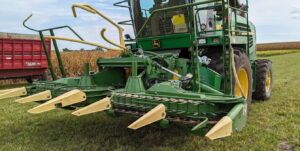
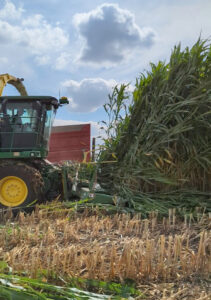
Sorghum was chopped using a forage harvester and new krone header. While Miscanthus (Left) is known for being a large warm-season grass, Sorghum is massive in comparison.
New biomass crop chopper header. This header is the same style as what is being used in commercial Miscanthus operations in the U.S.

The team at Iowa State University’s Sustainable Advanced Bioeconomy Research Farm (SABR) recently harvested and hauled 400 tons of sorghum. Harvest was completed quicker and more efficiently due to the help of some new equipment. Nic Boersma along with co-authors Andy VanLoocke, Marshall McDaniel, and Brian Hornbuckle wrote a proposal for the ISU Strategic Seed Grants for Facilities and Equipment call for spending Hatch funds.

According to Boersma, a research scientist in agronomy and site manager at SABR, “This proposal had the distinct goal of increasing the biomass harvest capabilities at the University. Ultimately, this proposal was accepted for funding by ISU and the USDA. The Department of Agronomy also generously contributed matching funds.”

Biomass sorghum harvest. This year's sorghum grew to nearly 15' dwarfing our forage harvester.
Biomass sorghum harvest. This year’s sorghum grew to nearly 15′ dwarfing our forage harvester.

In order to improve harvesting capabilities, the team requested a new style of chopper header that was larger and the best in the world at harvesting biomass crops. Boersma said the header worked exceedingly well and is 50% larger than the previous header. Additionally, they requested a harvest lab sensor that, along with the GPS capabilities in the chopper, gives them the ability to map yields within the field. Finally, they requested a new dump trailer to drastically increase their capacity for hauling material out of the field. The wagon is 1.5-2 times larger than their existing forage wagons, which allows them to save fuel, time, and the need for fewer people to complete the job. Although the trailer did not arrive on time, it will be available for use for the next big biomass harvest, which will be Miscanthus in the spring.

The team’s vision for the new equipment is to enhance and streamline biomass logistics for any group working on dedicated biomass crops, so Boersma says to reach out for more information about using the equipment. “We also cannot say enough good things about the farm crews at ISU. Without Nathan Meyers, Kent Berns, Steve Jonas, and their crews, this work would not have been possible. Moving forward, we are committed to further improving our processes and capabilities to ensure we are the premiere destination for biomass crop research in the U.S.,” said Boersma.

Note: Research conducted at the SABR Farm is funded by the Center for Advanced Bioenergy and Bioproducts Innovation (CABBI). Photos and article provided by Nic Boersma. For more information, please contact Nic Boersma.

In photo at top: Sorghum  harvest: Sorghum (on right side) was chopped using a forage harvester and new krone header. While Miscanthus (on left) is known for being a large warm-season grass, Sorghum is massive in comparison.

First-Time ISU–NRCS Organic Training Held in Ames

Dr. Delate, left, and Dr. Mallarino, right, speak during the recent ISU–NRCS Organic Training.

On September 12, over 65 producers and researchers attended the Iowa Natural Resources Conservation Service (NRCS) all-day training program on research-based organic practices from the ISU Organic Ag Program. USDA-NRCS soil conservationists, ISU professors and USDA-ARS soil scientists offered organic producers, and those with an interest in organic production, information on the latest ways to support organic practices. The group discussed cost-share programs for organic production and how to become organic certified through research-based practices.

Dr. Kathleen Delate, an organic specialist with ISU Extension and Outreach, said the event was very successful, from both an NRCS and farmer perspective. The training provided a review of organic opportunities offered by NRCS in their EQIP and CSP programs, as well as information on the new 823 Organic Management Practice Standard. In addition to Delate, speakers included Dr. Sabrina Ruis, soil scientist, USDA-ARS; Dr. Antonio Mallarino, agronomy, ISU; Kevin Kuhn, Iowa NRCS resource conservationist, and three organic farmers: Ron Rosmann, Paul Mugge and Scott Shriver. Details on Organic System Plans, which included nutrient and pest management plans, were presented along with examples of erosion and nutrient budgeting calculations for NRCS conservation practice standards.

Dr. Mallarino explained that, “Farmers need to understand how to calculate nutrients from manure applications, which is required for NRCS Nutrient Management cost-share programs. It is especially important for organic growers who rely on organic sources.” NRCS conservationists were equally grateful for the training, writing in their evaluations: “Really appreciated the organic farmer panel. It was nice to hear from producers that participate in NRCS programs and those who do not. For the producers who have not participated in programs, I appreciated hearing them share that flexibility was a concern, along with compliance. It’s good to know what the concerns are out there so we can work to try and alleviate them.”

The event was supported through a grant from the USDA National Organic Program Transitioning to Organic Partnership Program coordinated by Midwest Organic Services Association (MOSA): Midwest TOPP. For more information, contact Kathleen Delate.

In photo above, Dr. Delate, left, and Dr. Mallarino, right, speak during the recent ISU–NRCS Organic Training.

Pivot Bio Gives Agronomy Senior Well-rounded Experience

Agronomy senior Rebecca Noe

Rebecca Noe, a senior in agronomy, worked for Pivot Bio over the summer as a product development agronomy intern in Illinois. She was given the opportunity to scout and evaluate on-farm strip trials of future Pivot Bio products. This included soil sampling, tissue sampling, CCI meter use, stand counts, drone flights, and general observations of the quality of the trial. She also completed an intern research project regarding CCI meter use. In addition, she managed and completed her own individual intern project regarding corn moisture loss. The internship helped her better understand Pivot Bio’s products as well as their role in reducing synthetic nitrogen use.

“I had the opportunity to connect with several growers throughout the state of Illinois who are committed to reducing nitrogen loss on their farms. I enjoyed getting to know these growers, their operations, and their reasons for utilizing Pivot Bio products on their farms. I also enjoyed getting to work with Pivot Bio’s future products and evaluating them via large-scale field trials,” said Noe.

ISU Researchers Attend NSF’s AI Hill Day at the US Capitol

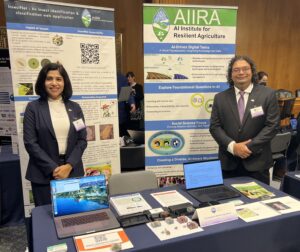
From left, NSF’s Sethuraman Panchanathan, Arti Singh, and Baskar Ganapathysubramanian.

On September 19, members of the Artificial Intelligence Institute for Resilient Agriculture (AIIRA), Dr. Arti Singh, agronomy, and Dr. Baskar Ganapathysubramanian, mechanical engineering and AIIRA director, attended the National Science Foundation’s AI Hill Day at the U.S. Capitol in Washington, D.C. Representatives from the nation’s 25 National AI Research Institutes were invited. Singh and Ganapathysubramanian shared AIIRA’s work on AI advances in agriculture (which included an InsectNet app) and STEM activities by Women in Ag and AI (WIAA). The InsectNet app is a web application that identifies and classifies more than 2,500 insect species using a model trained on 13 million insect images.

From left, Arti Singh, and Baskar Ganapathysubramanian.
From left, Arti Singh, agronomy, and Baskar Ganapathysubramanian, mechanical engineering, at the NSF’s AI Hill Day.

At NSF’s AI Hill Day, policy makers, congressional staffers, and other visitors had the opportunity to learn about real-world applications of AI and see firsthand the technologies transforming the AI field and the many ways in which federal investments in AI research are producing innovation, community partnerships, and workforce development.

“It was a very enriching experience to share our ongoing efforts and achievements with lawmakers at the Capitol,” said Singh. “It is exciting to be involved in building AI tools for smarter agriculture and to democratize the access of these AI tools in agriculture. I am also very excited about the WIAA group, as we empower women researchers and help create awareness to diversify our workforce with enhanced women participation.”

Singh explained that the WIAA, an ISU-based group funded by the AIIRA, was formed to increase participation and knowledge dissemination of AI tools and technologies among women. “The group comprises undergraduate and graduate plant science students in agronomy, engineering, computer science, plant pathology, entomology, and microbiology. WIAA routinely carries out demos, workshops, hands-on activities, and broadening participation events for undergraduate students, public and private sector stakeholders,” said Singh.

“This event allowed us to explain to a large spectrum of congressional staff and policy makers the impact of USDA-NIFA investments towards producing AI tools that can make agriculture resilient, profitable and scale-agnostic,” said Ganapathysubramanian.

About the AI Institutes and the AIIRA

Launched in 2020, the AI Institutes represent a $500 million investment connecting over 500 funded and collaborative institutions across the U.S. and worldwide. To learn more about the AI Institutes, visit National AI Research Institutes or nsf.gov.

The AIIRA was launched in 2021 after receiving a five-year, $20 million grant to establish the institute based at Iowa State University. AIIRA is a collaborative project involving faculty members from Iowa State University, the Iowa Soybean Center, the University of Arizona, Carnegie Mellon University, George Mason University, the University of Missouri, the University of Nebraska-Lincoln, and New York University. It is supported through funding by the USDA – National Institute of Food and Agriculture.

Top photo from left, NSF Director Sethuraman Panchanathan with Arti Singh, agronomy, and Baskar Ganapathysubramanian, AIIRA director, mechanical engineering.


Exploring new sorghum cultivars’ potential as forage crop for Upper Midwest

sorghum harvest

AMES, Iowa – Sorghum is a productive and versatile annual crop used worldwide for livestock feed. Until now, the plant, which originated in the tropics, has done best in warmer regions with longer growing seasons than the Upper Midwest.

A new USDA-supported project will test and release several new sorghum cultivars that promise high-yielding, nutritious forage for beef and dairy cattle operations in the north-central states.

The project will be led by Maria Salas-Fernandez, associate professor of agronomy at Iowa State University, who directs the northernmost public sorghum breeding program in the United States.

The effort is funded by a $498,960 grant from the USDA National Institute of Food and Agriculture’s Agriculture and Food Research Initiative. It will facilitate evaluation of Salas-Fernandez’s sorghum parental lines created from germplasm adapted for northern growing conditions, including drought-prone areas with sandy soils and low organic matter in the Dakotas and Wisconsin.

“Sorghum offers a number of economic and environmental benefits,” Salas-Fernandez said. “The seed is cheaper than corn, and it grows well with fewer inputs of pesticides and fertilizer. At the same time, it is an annual crop that uses similar equipment and familiar cultivation methods, so it fits well with conventional crop rotations in this region.”

Partners on the project are Christopher Graham and Sara Bauder, South Dakota State University Extension; Marisol Berti, North Dakota State University; and Matt Akins, USDA Agricultural Research Service Dairy Forage Research Center in Wisconsin.

The team of researchers will evaluate advanced experimental sorghum hybrids for alternative systems (hay, green chopping, grazing and silage) in regional trials at eight locations in Iowa, North Dakota, South Dakota and Wisconsin. Additionally, the treatments will be evaluated to help select the best performing hybrids for those production systems and locations and refine management recommendations.

“Our overall goal is to take the next steps to make new sorghum germplasm available for public use to benefit beef and dairy producers in northern states to improve the profitability and sustainability of their farming operations,” Salas-Fernandez said. “It will also be especially valuable to numerous small and mid-size seed companies that do not have proprietary sorghum germplasm and help them supply the best performing cultivars for their northern clients.”

Another focus of Salas-Fernandez’ work has been the development of sorghum strains tailored for biomass production in northern latitudes. Tests of those materials in Iowa and Michigan, including at the Great Lakes Bioenergy Research Center, have had promising results.

In photo above: Harvesting a sorghum field for yield trials conducted each year by Iowa State to evaluate biomass yield for hundreds of new hybrids. Photo courtesy of Maria Salas-Fernandez.

Contacts

Maria Salas-Fernandez, 515-294-9563, mgsalas@iastate.edu

Ann Robinson, Agriculture and Life Sciences Communications, 515-294-3066, ayr@iastate.edu

Ag professor father and son duo develop proso millet as crop for the future

Patrick & James Schnable

Ames, IA — The Food and Agriculture Organization of the United Nations has declared 2023 as the International Year of Millets, but these crops are unfamiliar to many Iowa farmers.

Expect that to change soon say plant-breeding father and son team Patrick and James Schnable, co-founders of the Ames-based company Dryland Genetics. They think proso millet (Panicum milaceum) can make midwestern agriculture more resilient and more profitable.

Proso millet is a hardy cereal grain that requires about half the water corn needs per bushel of grain produced.  Its management is similar to corn, although it can be grown in the Midwest without the need to apply expensive nitrogen fertilizer. Farmers can use the same equipment they already use to plant and harvest corn or beans. Proso millet’s short growing season and late planting date means the crop could mesh well with rotations that include a winter annual crop, such as winter canola, camelina or winter peas.

Currently, proso millet is often sold in the U.S. as bird seed and in gluten free health foods. It can substitute for most of the uses of corn, including as feed for livestock and ethanol production. Millet also has a low carbon score, making it a crop  that could qualify for incentives from industry and agencies seeking greenhouse gas reduction credits.

Proso millet is already grown on hundreds of thousands of acres in the U.S., yet it hasn’t become widely popular. For comparison, corn is grown on about 90 million acres each year.

“In large part, that’s because there has been little work to improve millet, which has not historically been a highly productive plant per acre,” said Patrick Schnable. “It has taken huge investments and almost 100 years of breeding to make corn the crop so many across the globe depend on today. Yet as corn yields rise, so do its water demands. As access to water becomes more limited in the future, we expect demand for a water-thrifty crop like proso millet to increase.”

A plant that can tolerate neglect

Patrick Schnable is the Iowa Corn Endowed Chair in Genetics and director of the Plant Sciences Institute at Iowa State University. His son, James, is the Charles O. Gardner Professor of Agronomy at the University of Nebraska-Lincoln. As plant scientists with extensive expertise in corn genetics, they both have interest in other promising crops.

The idea that became Dryland Genetics was originally born in 2013 when James was running an experiment with more than a dozen grains. After the test was over, he forgot about the plants, and they were left in the greenhouse with no one to water them. Everything died — except for the millet. “It was exciting to see that a crop could tolerate that level of neglect,” James Schnable said.

Then and there, they were inspired to create a start-up. In the decade since, they have been using their expertise to improve proso millet yields through genotyping and breeding. They have been testing the plants’ viability under different growing conditions and building markets for the best performing varieties.

Small grain with green stalks and tan seed heads growing outdoors.
Proso millet


Startup help

Patrick and James had both had some successes with other plant breeding businesses. They had also managed large grants from federal agencies and industry. Such experience helped them secure investments in Dryland Genetics from important investors, initially led by the private Ames Seed Capital group, and later, from the Iowa-based firm Next Level Ventures and the seed company run by Iowa’s only billionaire, Harry Stine. The Schnables also sought help from Iowa State resources, including the Iowa State Research Park south of the university, where Dryland Genetics is located.

“We looked at other places as a home for our company, but it was going to be challenging to find the space that would fit our needs,” James Schnable said. “The Research Park staff worked with us to help customize a space and a lease that would work and could change as we grew.”

“Iowa State encourages public-private partnerships and can provide important consulting help to fledgling businesses,” said Patrick Schnable, referencing ISU’s Digital & Precision Ag Economic Development Platform. “Iowa State is also one of small number of universities in the United States still investing in cutting-edge plant breeding,” he said. “This human capital makes Iowa State a great place to work on quantitative genetics and breeding, whether for corn or other crops.”

On-farm investor

Jeff Taylor, one of the early investors in Dryland Genetics, is now its board chair. He is also one of the farmer partners growing the company’s millet to produce seed for trials and early sales.

An Iowa State alumnus in agricultural studies, Taylor owns and manages his fifth-generation family farm north of Ames. Last year he grew 35 acres of millet. This year, he’s expanded the acreage devoted to the crop.

“Proso millet has been easy to grow so far, and last year, our new varieties had record yields,” Taylor said. “It’s a short season crop that fits in well with our current cropping system. It doesn’t need much tillage, water or fertilizer, and it uses equipment we already have. It emerges fast and quickly shades out competition between the rows.”

Taylor credits help he has received through Iowa State’s BioCentury Research Farm, especially from Levi Powell, manager of research, and Ben Covington, research scientist. “Their experience and depth of technical knowledge of machinery helped make sure each seed was planted properly this spring,” Taylor said.

“I’ve been looking for ways to make my farm more diversified, and I think this has real potential as a high-value crop for the future,” he said. “It has so many uses, including for human consumption and for livestock feed. It’s gluten free. Research shows that it could be a good grain to blend in ethanol, and it could be eligible for payments through emerging carbon markets.”

One of the biggest challenges is getting millet better integrated into the country’s crop insurance programs – a big influence on farmers’ decisions about what to grow, according to Taylor.

“Proso millet is already being grown in the U.S., and there’s growing interest in areas facing water shortages,” he said. “It’s not a new crop. We’re just making it better.”

More grain, less water

Dryland Genetics’ mission is to develop proso millet as the climate conscious choice of farmers and consumers across the world. The company is already seeing significant yield gains. Importantly, the higher yielding varieties remain thrifty water users.

“Water is going to be a major limiting factor for agriculture in much of the world,” Patrick Schable said. “Even here in this country, water supplies are drying up. This is a matter of food security and rural prosperity. We need ways to supplement corn and other crops that are heavy water users. I strongly believe that proso millet is one of the answers to this serious challenge.”

Contacts:

Patrick Schnable, Iowa State University Plant Sciences Institute, 515-294-0975 schnable@iastate.edu
James Schnable, Dryland Genetics, 531-333-3549, james.schnable@drylandgenetics.com
Ann Y. Robinson, Agriculture and Life Sciences Communications, 515-294-3066, ayr@iastate.edu

Syngenta Internship Provides Student with Valuable Experiences

Aidan Bobholz

September 12, 2023 – Aidan Bobholz, a junior from Randolph, WI, majoring in agronomy and seed science had the opportunity to work for Syngenta in Slater, IA, over the summer through a Discovery Breeding Internship. With an avid interest in plant breeding, he had previously worked at companies as an intern in corn breeding. During his internship at Syngenta, he not only gained more experience in corn breeding, but also was able to gain experience that would complement his minors in data science and international agriculture.

Aidan Bobholz
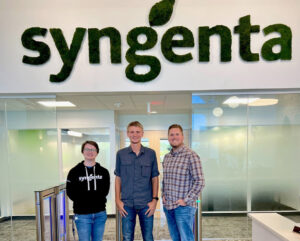
From left, fellow intern Ryleigh Grove, University of Nebraska, Aidan Bobholz, Iowa State, and Scott Stelpflug, Syngenta.

According to Bobholz, the discovery team at Syngenta works on integrating evolving technologies, new ideas for plant breeding, and data science into the main market pipeline for Syngenta breeding, which allowed him to work with data scientists, corn breeders and a soybean breeder. He said his team lead, Scott Stelpflug, was instrumental in connecting him with a data scientist who taught him how to use R, a program language like Python. R is heavily focused on data science and cleaning data sheets. He used RStudio (an interface that makes writing in R easier) to create linear regression modeling systems for a characteristic of corn.

Bobholz explained, “I was able to make this model more accurate by the end of the summer and got interested in its use from the main breeding team. Along with data science, I was able to walk the field with Travis Beckett, the DB breeder for 100-110RM, and learned about what he looks for in the nursery in different generations. I took flowering notes and tassel ratings in his nursery for him. This experience helped me begin in the development of my data science skills and allowed for me to work on them whilst creating a useful application for breeding.”

He also gained more knowledge in corn breeding saying, “I learned a lot about the germplasm and genetics of the current corn used in most breeding programs, being the NSS and SS heterotic pools.”

Top photo from left: Aidan Bobholz, Ryleigh Grove, Jon Renk (DB 80-100RM DB Corn Breeder, Syngenta) , Nick Wiering (DB Soybean Breeder, Syngenta)


Contacts:

Kara Berg, Department of Agronomy


Suza named George Washington Carver Endowed Chair

Dr. Walter Suza

August 22, 2023 – Walter Suza wants to do what George Washington Carver did — feed the hungry.

And Suza, adjunct associate professor in Iowa State University’s Department of Agronomy and the new George Washington Carver Endowed Chair, has proven he knows how to do it.

Suza’s role as chair started Aug. 15, following Andrew Manu, professor emeritus of agronomy, who held the position since 2009.

“I expect Dr. Suza will do great things in this position,” said Mary Wiedenhoeft, interim department chair and Morrill Professor in the Department of Agronomy. “His passion for fighting food insecurity will be an asset to the continued success of the George Washington Carver Endowed Chair position and the expansion of the agronomy department.”

Suza began applying lessons from his youth to solve hunger when he worked for the World Food Program in Angola and UNICEF in Zimbabwe in the 1990s.

“When I was a child in rural Tanzania, I experienced hunger in school,” Suza said. “Education helped me rise above inequity, yet if Africa University had not provided me with financial aid, I would not have completed my undergraduate education. My undergraduate education at Africa University convinced me that education is a powerful tool to fight hunger. With a college degree, I was able to find employment with the United Nations.”

In his roles with the World Food Program and UNICEF, Suza worked in food security assessment, mapping vulnerable households and coordinating food aid to households affected by civil war and drought, areas that were critical to achieving his goal of feeding the hungry.

Just like George Washington Carver did.

“It became apparent to me during my employment with WFP and UNICEF that limited access to education contributed to food insecurity,” Suza said. “Today, I am educating the next generation of agronomists who will play a greater role in ending hunger in the world.”

Suza earned his bachelor’s degree in agriculture and natural resources from Africa University in Zimbabwe, his master’s degree in agriculture with an emphasis in soil science from Murray State University and his doctorate in agronomy with an emphasis in plant molecular biology from the University of Nebraska-Lincoln.

He came to Iowa State in 2011 to develop courses for the Distance Master’s in Plant Breeding program. He went on to serve as director of the Plant Breeding e-Learning in Africa Program for eight years.

Suza teaches courses on genetics and crop physiology for agronomy majors. He is also increasing access to free educational resources for both Iowa State students and the rest of the world. These resources have reached more than 86,000 people all over the world.

“George Washington Carver was a pioneer here as a student and faculty member, beginning in 1891, and left Iowa State for the Tuskegee Institute to further reach his goals of science and service,” said Daniel J. Robison, holder of the endowed dean’s chair in the College of Agriculture and Life Sciences. “Walter Suza, who is here at Iowa State to inspire the next generations of great students, following in Carver’s footsteps.  Suza is in a wonderful position to honor and expand upon Carver’s legacy and help move our college further forward. I know he will accomplish great things.”

Additionally, Suza is interested in empowering farmers to produce more and healthier food.

Just like George Washington Carver did.

Carver served producers and consumers by improving soil technology and developing novel uses of common agricultural products.

Like Carver, Suza’s research on plant sterols is aimed at serving all farmers with healthier food crops that are more resilient to limited water supplies due to the changing climate.

“I dream of a world where every child has access to sufficient and nutritious food,” Suza said. “I dream of an America where every child has access to lunch in school regardless of their socioeconomic status.”

Suza said he hopes to honor Carver with his work as the endowed chair.

“It’s not about me, really,” Suza said. “It’s an honor to be associated with Carver. I’ll never understand what it feels like to have gone through all that he did — he was born a slave; he faced racism, even here in Iowa. We need to honor him. We need to tell his story.”

Contacts:

Walter Suza, Department of Agronomy, 515-294-4138, wpsuza@iastate.edu
Madelyn Ostendorf, Agriculture and Life Sciences Communications, 515-294-8892, madelyno@iastate.edu