Setting incoming agronomy students up for success, one trip at a time

Agronomy Learning Community group photo

The 2022 Agronomy New Student Learning Community traveled to the southeast part of the state prior to the start of the fall 2022 semester. Each year, incoming freshmen agronomy students tour farms, businesses and natural areas in a different quadrant of the state the Friday and Saturday before classes start to learn about all the agronomy field has to offer.


August 16, 2023

By Whitney Baxter

What better way to begin your time as an agronomy student than loading up on a bus, traveling around parts of the state and getting to know fellow classmates and instructors?

For the past 25 years (minus one year due to COVID), the Department of Agronomy has been taking incoming freshmen students on the annual Agronomy New Student Learning Community field trip the Friday and Saturday before the fall semester begins. Visiting a different quadrant of Iowa each year, the students tour farms, businesses and natural areas to expose them to all the agronomy field has to offer.

Transfer students take part in an afternoon field trip to get to know each other and departmental research faculty.

The pre-semester trip is what makes the learning community unique.

“It’s a great opportunity to build community among students, faculty and staff. Students can gain an understanding of career paths and summer internship opportunities within agronomy,” said Heidi Ackerman, agronomy academic advisor and learning community leader. She is also a former learning community member, having earned her agronomy degree in 2013.

Wyatt Bailey, senior in agronomy, served as one of the learning community’s peer mentors during his sophomore year. That year’s trip took students to southwest Iowa, with stops at a land and cattle company and the birthplace of Henry A. Wallace, an Iowa State alumnus and founder of Pioneer Hi-Bred International.

Two male students taking part in a hands-on activity related to soil and water. They, and a few other students, are standing around a white folding table outside.
During the annual field trip, freshmen agronomy st During the annual field trip, freshmen agronomy students take part in various hands-on activities to help them learn about agronomy-related topics and practices

“The importance of this field trip every year is, first and foremost, to provide an opportunity for incoming agronomy freshmen to gain an insight into Iowa agriculture while building relationships with their peers and networking with faculty and staff,” Bailey said. “By being a peer mentor on this trip, I got to experience first-hand the friendships that formed, and as the year went on, I got to see those friendships strengthen.”

Brooklyn Denger, sophomore in agronomy, participated in the learning community last year. She appreciated how her involvement made the transition to Iowa State easier.

“At the beginning of my freshman year, I was afraid that I wouldn’t fit in, and that the university would be too large to form deep connections with others in my major,” Denger said. “However, the learning community allowed me to interact with a smaller group of people with similar interests. It made me feel more at home and comfortable at Iowa State.”

Beyond the start-of-the-semester field trip, the learning community students enroll in the same sections of required English 150 and English 250 courses. These class sections are tailored to include agriculture-related writing and reading assignments. The students also take other class sections together, including those for Chemistry 163, Math 140, Biology 212 and several 100-level agronomy courses.

Various social and community service events are also scheduled throughout the academic year to continue building relationships outside the classroom setting. Learning community members also meet with the peer mentors weekly to talk about internship opportunities, advice for classes and how to access resources on campus.

“Every week, I provided a piece of information or advice that I believed was valuable for an incoming student, having been an ‘experienced’ student myself,” Bailey said. “I learned just as much from my mentees as they did from me.”

Tyler Reimers, another former learning community member, graduated in 2012 with his agronomy degree. He is now an assistant agronomy division manager for Farm Service Co-op in Harlan, Iowa. In his profession, he often comes across people in the agriculture industry who are Iowa State graduates and have taken part in the agronomy learning community.

“It gave me a firm footing to feel comfortable being at Iowa State, and it exposed me to the many options in the agronomy field,” Reimers said of the learning community. “I was able to build a network of people to turn to when I have questions, even today.”

Mary Wiedenhoeft, interim chair and Morrill Professor in the Department of Agronomy, said the learning community has increased student success in the department.

“We want to set our students up for success early on in their academic careers, and the Agronomy New Student Learning Community does just that,” Wiedenhoeft said. “It is so rewarding to hear former students talk so highly of the learning community and its positive impacts on their time at Iowa State and now as working professionals. We hope the program will continue positively influencing agronomy students for years to come.”


Yu to lead Iowa State’s Baker Center for Plant Breeding

Headshot of Jianming Yu

August 14, 2023 – Jianming Yu will become the fourth director of the Raymond F. Baker Center for Plant Breeding at Iowa State University, effective Aug. 16. He will replace Thomas Lübberstedt, who has served as the center’s director since 2007.

AMES, Iowa – Jianming Yu’s extensive background in plant genetics and breeding research will serve him well in his new role as director of the Raymond F. Baker Center for Plant Breeding at Iowa State University.

Yu is a professor and Pioneer Distinguished Chair in Maize Breeding in Iowa State’s Department of Agronomy. He is known as one of the top scientists in the world for quantitative genetics, which interfaces plant breeding, genomics, molecular genetics and statistics.

His role as Baker Center director takes effect Aug. 16, following Thomas Lübberstedt, K. J. Frey Chair in agronomy, who has served as the center’s director since 2007.

“Professor Yu is not only an eminent scientist, but also has a special ability to engage and excite faculty and graduate students about new opportunities in plant breeding,” said Patrick Schnable, Distinguished Professor of agronomy and director of Iowa State’s Plant Sciences Institute. “As such, I believe as director, he will foster innovation at the center.”

Yu has been a faculty member at Iowa State since 2013. Much of his research focuses on developing and implementing new strategies and methods in complex trait dissection and crop improvement.

As the center’s incoming, fourth director, Yu plans to use his experience to further Raymond F. Baker’s vision to enhance plant breeding programs for diverse crops – from major row crops to emerging new crops. Yu also plans to use new and future technologies available in the plant breeding field.

“I would like to see the Raymond F. Baker Center for Plant Breeding better known as a center of plant breeding innovations through technology, analytics and design. Efforts will be devoted to research, training and communication to make this happen,” Yu said.

In addition to his research responsibilities, Yu teaches Agronomy 621: Advanced Plant Breeding each spring. In the class, graduate students learn how to create a research plan and use advanced technologies to better understand and improve plant breeding methods. He encourages students to think creatively and critically and not be afraid to ask questions.

Further plant breeding learning opportunities will continue to be offered to students through positions at the Baker Center under Yu’s leadership.

“We appreciate Thomas Lubberstedt for his 16 years of dedicated leadership and service as the director of the center,” said Mary Wiedenhoeft, Morrill Professor and interim department chair of agronomy. “We anticipate that Yu’s ongoing leadership training as a member of LEAD21’s Class 19 will facilitate this transition and move the center forward.”

Yu’s work led to him being named a Fellow of the American Association for the Advancement of Sciences in 2018. That same year, he was named a Fellow of the Crop Science Society of America. Other awards he has received include the Raymond and Mary Baker Agronomic Excellence Award from the Department of Agronomy and the Mid-Career Achievement in Research Award from Iowa State.

He earned his bachelor’s degree in agronomy from Northwest Agriculture and Forestry University in China and his master’s in agronomy from Kansas State University. He also holds a doctorate in applied plant sciences from the University of Minnesota.

About the R. F. Baker Center for Plant Breeding

Founded in 1999, the Raymond F. Baker Center for Plant Breeding aims to advance the science of plant breeding through hypothesis-driven research, the development of enhanced germplasm of diverse crops, and the education of students and postdoctoral fellows. The center is affiliated with Iowa State’s Plant Sciences Institute and Department of Agronomy.

The center was established to further the work of its namesake, Raymond F. Baker, who earned his bachelor’s degree in agronomy from Iowa State in 1935. Baker went on to work as a lead plant breeder at Pioneer Hi-Bred International for more than 40 years. He is known for developing many of Pioneer’s first corn hybrids, using techniques and procedures learned under the guidance of Henry A. Wallace, founder of what was then called Pioneer Hi-Bred Corn Company and former U.S. Secretary of Agriculture. Baker was awarded an honorary doctoral degree from Iowa State in 1991.

Aligning with Baker’s beliefs in advancing plant breeding for future generations, Yu has sought to establish a culture of respect, encouragement and collaboration during his time at Iowa State. He plans to continue to prioritize these values in his new position.

“Continued promotion of the Baker Center, its members and our research are needed to make things possible in terms of increasing collaboration with other faculty and institutions, being considered as a partner, attracting the attention of potential graduate students, detecting new research trends and generally establishing a reputation for excellence in different research areas,” Yu said.

Contacts

Jianming Yu, Department of Agronomy, Baker Center for Plant Breeding, 515-294-2757, jmyu@iastate.edu

Whitney Baxter, Agriculture and Life Sciences Communications, 515-294-2314, wjsager@iastate.edu


CALS Entrepreneurship Fellow innovates to deliver engaging course material and save students money

Walter Suza is making plant genetics educational materials more engaging and accessible for students on campus and far away.

An adjunct associate professor in agronomy at Iowa State University, Suza teaches the Genetics 320: Genetics, Agriculture and Biotechnology class in his department for several years. From the beginning, he was dissatisfied with the textbook options. The information that was most relevant to agronomy students was limited and came at a high price.

“I thought there must be a better way than to assign a $200 textbook that we only use a few chapters from,” he said. He also found the available materials lacked hands-on examples or online demonstrations to reinforce concepts and laboratory techniques.

These challenges inspired Suza to create a new, open educational resource for the course – an OER in instructional lingo – with support from a Miller Open-Education Mini-Grant through Iowa State’s Parks Library. The OER materials, especially tailored for agriculture majors, were first introduced in 2021.

Now, Suza and a team he recruited for the project, are creating a new set of Applied Learning Activities (ALAs) to enhance the lessons. They received seed money and support through Suza’s participation in the Innovation and Entrepreneurship Faculty Fellows Program sponsored by the College of Agriculture and Life Sciences Dean’s Office of Academic Innovation and Start Something CALS.

Suza’s main collaborators have been Abbey Elder, an Iowa State librarian with expertise in educational instruction and accessibility, and Professor Don Lee, a long-time instructor in genetics at the University of Nebraska-Lincoln. Students have also helped with creation of the ALAs, editing and packaging materials for online access, including Marjorie Hanneman, who graduated in 2021 with genetics and agronomy degrees, and Stephen Gray, a graduate student in agronomy.

Cover of Genetics, Agriculture and Biotechnology textbook by Walter Suza and Donald Lee
Cover for new OER educational resources for the Iowa State’s Department of Agronomy Genetics 320 course.

Suza’s own credentials for the job include more than a decade of experience developing and delivering online educational resources for graduate students and professionals with the successful Plant Breeding E-Learning for Africa  curriculum, and as a course developer for Iowa State’s online Master of Science in plant breeding.

His team’s new genetics text covers basic topics, such as the life cycle of a cell, DNA and how it relates to genes and chromosomes, and more sophisticated DNA analysis and genetic biotechnologies.

“With the addition of the ALAs, we’ll be able to even more strongly approach genetics in the context of why the concepts matter and how to use them to solve problems,” Suza said.

“For instance, when you engineer a new gene into a plant, it’s important to learn how to find evidence that the new gene is working. What changes in the growth and development of the transformed plant will you look for? I provide results from my own research so students can start learning how to work with often-messy data to answer such questions.”

As a teaching assistant for Genetics 320, Gray, now working as a plant breeder for industry and finishing his master’s project, said he found the addition of applied, real-world examples reinforced the concepts to improve students’ understanding. “One of the core things I take with me was Dr. Suza’s emphasis on service to students that the OER represents,” he continued. “Textbooks for general education courses can get so expensive – some students just can’t afford them. I saw how having the materials available to everyone helped alleviate stress and created a better learning environment.

While Suza’s fellowship is finished, the OER team continues to compile video resources and ALAs for the project. Additional contributors have also been recruited, including Amy Toth, Iowa State professor in ecology, evolution and organismal biology, who is sharing course material on bee genetics.

“This is a huge project, but we expect to have the set of ALAs completed this fall. A lot goes into developing modern instructional technology,” Suza said.

“One of the biggest challenges with creating OER materials is how to fund and sustain a high-quality, free resource. The demand is out there, though,” he said, referencing more than 86,000 online users so far. At least two institutions have adopted the OER, including Trinity Washington University in Washington, D.C., and a university in the Philippines.

Among Suza’s next steps is a market analysis to create a long-term business plan for the project, with help from new mentors that have come through the CALS faculty fellows program.

Former Department of Agronomy Chair Kendall Lamkey, now CALS associate dean for facilities and operations, has been supportive of Suza’s initiative since early on. Lamkey, who has a background in plant breeding, knows the challenges students often have with the course.

“I applaud the work that Walter and his partners on this project are doing to make the topic more relevant to our students’ interests and future careers. Not only that, Walter and his team have helped develop a great platform for this and future OERs that will be more permanent, accessible and relatively easy to update. They have a good, student-centered product, and it’s great to see the impressive interest in it.”


Article by Ann Y. Robinson, CALS

In Photo at top: Walter Suza, adjunct associate professor in agronomy (second from left), was recognized as one of Iowa State’s first Innovation and Entrepreneurship Faculty Fellows at an event in spring 2023. With him, from left, are: Daniel Robison, holder of the College of Agriculture and Life Sciences Endowed Dean’s Chair; Kevin Kimle Rastetter Chair of Agricultural Entrepreneurship and director of Start Something College of Agriculture and Life Sciences; and Carmen Bain, CALS Associate Dean for Academic Innovation. 


MS Agronomy Program Celebrates 25 years!

Photomosaic of graduates and staff involved in MS Agronomy Program, showing the program's logo as background image.

A first of its kind: Master’s in Agronomy program marks 25th anniversary

A discussion over cups of coffee in 1995 about how students were commuting to Ames for master’s degree programs resulted in the formation of a program that would lead the way in distance education at Iowa State University.

The Master of Science in Agronomy program celebrates its 25th anniversary this summer. Offered as a distance education program, it stemmed from an identified need to provide a master’s degree option that would better align with working professionals’ schedules.

Read the whole article by Whitney Baxter here.

Iowa State University research on genetic mutations aims to advance plant breeding


AMES, Iowa – Growing populations and shrinking agricultural resources are among the most important challenges facing food production. To meet projected increases in global demand for food, feed and fiber, experts say progress is needed to accelerate genetic improvement of crops.

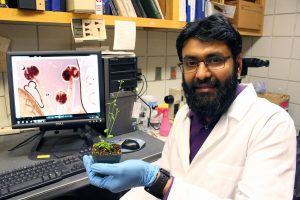
The USDA National Institute of Food and Agriculture has awarded $649,443 for a three-year grant led by Siddique I. Aboobucker, research scientist in agronomy at Iowa State University, working with Thomas Lübberstedt, Frey Chair in Agronomy and director of the Raymond F. Baker Center for Plant Breeding. Their project will investigate genetic mechanisms that could be used to improve doubled haploid processes to create pure genetic lines for breeding corn and, eventually, other crops.

Use of DH method is one of the basic technologies underpinning modern corn breeding. It can speed up inbred line development by reducing the number of generations from seven in traditional breeding to two generations in DH breeding, according to Aboobucker.

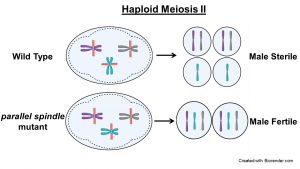
However, DH technology has significant challenges. It requires creation of haploid plants that carry only a single copy of the genome. Resulting haploid male flowers are usually sterile. Overcoming this problem has required exposing the seedlings to the toxic chemical colchicine in a labor-intensive and costly process that spurs genome doubling and returns fertility to haploid male flowers.

In earlier work, Aboobucker and colleagues demonstrated that exploiting mutations which modify the positioning of the spindle mechanism during the plant reproductive phase known as meiosis can restore male fertility of haploid plants. Aboobucker’s new project will build on this work by advancing identification and manipulation of genetic mutations that could more easily restore haploid male fertility in maize while avoiding the need for chemicals.

“The genetic mechanisms I’m exploring have great potential to make the technology for inbred line creation in maize more efficient and more widely available,” Aboobucker said. “As the same genes are also conserved in a number of other plant species, the research opens the possibility to apply the results to other crops in the future.”

Lübberstedt takes new role leading National Association of Plant Breeders

Dr. Thomas Lübberstedt

AMES, Iowa — Iowa State University professor Thomas Lübberstedt assumed the role of president of the National Association of Plant Breeders at the organization’s annual meeting, July 16-20, in Greenville, South Carolina, hosted by Clemson University.

Lübberstedt, K. J. Frey Chair in Agronomy, is currently the university’s director of the Distance Master’s Program for Plant Breeding.

As president of NAPB for the next year, he will lead a diverse group of scientists and graduate students in plant breeding and related fields. The organization fosters networking between public and private sectors, provides advocacy for plant breeding, and advances excellence in research, education and outreach. As vice-president, Lübberstedt co-chaired the planning committee for NAPB’s 2022 conference in Ames with Paul Scott, a research geneticist with the USDA Agricultural Research Service.

NAPB has a close connection to the Plant Breeding Coordinating Committee, which represents plant breeders at land-grant universities. Lübberstedt is currently Iowa State’s representative on that national group.

“I’m honored to help promote plant breeding as a profession through NAPB,” Lübberstedt said. “I’m taking on this role at a good time. The volunteer organization has active strategic planning efforts and grown its membership in recent years, something I hope to see continuing. That includes increasing interaction with related organizations and international plant breeders so we can learn from each other.”

Lübberstedt joined Iowa State’s Department of Agronomy in 2007. He founded the Doubled Haploid Facility at Iowa State and served as director of the Raymond F. Baker Center for Plant Breeding from 2007-2023. His research at the university has focused on identifying and efficiently exploiting valuable genetic diversity in corn and perennial grasses to be used in plant breeding. His primary research area is manipulation of plant reproduction to accelerate the breeding process.

Lübberstedt grew up on a farm in Hamburg, Germany, where his experience raising vegetable and ornamental crops inspired his career. He earned his doctorate in biology from the University of Munich, and degrees in agronomy from the University of Hannover and the Technical University of Munich.

View a July 20, 2023, Seed World interview with Thomas Lübberstedt on plant breeding and taking leadership at NAPB, by Marc Zienkiewicz.


Photo: Thomas Lübberstedt, professor, Iowa State, takes the gavel from Hannah Senior, PBS International, to assume leadership of the National Association of Plant Breeders, in July 2023. Photo by Marc Zienkiewicz, Seed World.

Interim Department Chair: Wiedenhoeft begins new role

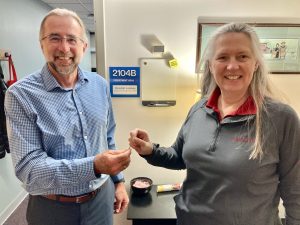
Kendall Lamke hands office key to Mary Wiedenhoeft

Dr. Kendall Lamkey, outgoing Agronomy Dept. Chair, hands over the office key to Dr. Mary Wiedenhoeft, Interim Dept. Chair. Wiedenhoeft officially began her new role Tuesday, May 16.


AMES, Iowa – Mary Wiedenhoeft will begin leading Iowa State University’s Department of Agronomy as interim department chair, effective May 16, 2023.

Wiedenhoeft, Morrill Professor of Agronomy, will take over for current department chair Kendall Lamkey, who has accepted the role of associate dean for facilities and operations for Iowa State’s College of Agriculture and Life Sciences.

“Dr. Wiedenhoeft has proven herself to be an excellent leader within the Department of Agronomy,” said Daniel J. Robison, holder of the endowed dean’s chair in the College of Agriculture and Life Sciences. “Her ability to connect with others and encourage them to reach their full potential is admirable, along with her extensive background in sustainable agriculture and cropping systems. I am delighted Dr. Wiedenhoeft has agreed to take on this interim position.”

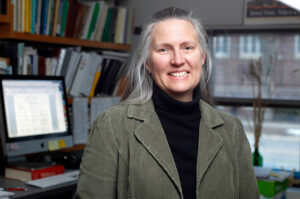
Mary Wiedenhoeft (Photo by Christopher Gannon)

Wiedenhoeft earned her bachelor’s degree in agronomy from Iowa State, then obtained her doctoral degree in crop physiology from Washington State University. After 12 years on the faculty at the University of Maine, she joined Iowa State’s Department of Agronomy in 1999. She currently serves as the associate chair for academics and director of the Masters in Agronomy Program.

Through the years, Wiedenhoeft has taught courses on the introduction to crop science, systems analysis in crop and soil management, and integrated crop and livestock production systems. Last fall, she took students on a Study USA trip, exposing them to the production and processing systems of various crops in North Dakota, South Dakota and Nebraska.

She also advises students in the department and, for many years, led the agronomy learning community. Her efforts to positively impact students and help them succeed in their academic journeys was acknowledged by her selection as the CALS Outstanding Advisor Award winner in 2017.

Wiedenhoeft’s research has focused on sustainable agriculture, agronomic education and the production and management of alternative cropping systems.

“I have really appreciated Kendall’s leadership; he has been an excellent leader. It’s amazing that many of the current faculty have known no other department chair,” Wiedenhoeft said. “I think the department is ready for the challenge of the transition, but it will take everyone working together. I am honored and excited about the opportunity to lead the department into the next era.”

Wiedenhoeft will further the department’s excellence in all mission areas, build on it with her colleagues and prepare the department for the next chair. A search for a new department chair will begin shortly, Robison said.

“It has been an honor to serve the Department of Agronomy for the past 16 years,” Lamkey said. “I am confident Dr. Wiedenhoeft will be a visionary and thoughtful leader during this time of transition. Her years of experience and knowledge of the department will serve her well and enable her to support our faculty, staff and students in working together to advance agriculture.”

Housed within the College of Agriculture and Life Sciences, the Department of Agronomy focuses on discovering new conservation methods, improving soil health, taking new approaches to bioenergy and advancing the genetic traits of plants. There are more than 35 faculty and 60 staff in the department, and approximately 400 undergraduate and graduate students.


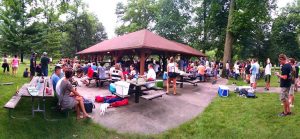
Spring BBQ at Brookside Park, May 18, 6:30pm

Agronomy department people gathjered at a picnic at Brookside Park.

AGSC 2023 Spring BBQ at Brookside Park

With the Spring semester over and temperatures warming up, let’s get together before the summer kick-off!

  • BBQ and refreshments provided by the Club. 
  • Ice Cream provided by the DEIB Committee. 
  • Side dishes are welcome! 

May 18th, 6:30 PM

Maple Shelter Brookside Park
Sign up here! tinyurl.com/agscBBQ

• Yard games available
• Every member of the Department is welcome to join!

Click here to see the whole flyer!
Join the Club! www.stuorg.iastate.edu/agrgrad/join
people at a picnic

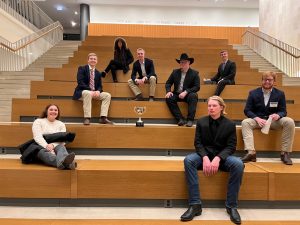
Iowa State Crop Judging Team named co-national champion

The 202 ISU Crops Team is a co-national champion! The team had great week placing 2nd overall as a team in Kansas City and 1st overall as a team in Chicago (which leads to the co-national champions).

“I’m very proud of this group and what they’ve accomplished,” said Mindy Devries-Gelder, team adviser.

The official team consisted of Megan Blauwet, Alex Coughlin and Tom Thompson as well as alternates Tyler Atkinson, Alex Cecil and Ephraim Van Zante, plus assistant coaches Wyatt Bailey and Caitlyn Bruntz. Wyatt and Caitlyn placed high enough last year to be ineligible to compete.

All-American status indicates 95% or above which is very difficult to achieve.  Alex and Megan were the only overall All-Americans in Chicago for the entire contest and Megan pulled a very rare occurrence by placing All-American in all three events in Kansas City.

Thanks to the Department of Agronomy and the Iowa Crop Improvement Association for their continued support of the team.


Official results

American Royal National Collegiate Crops Contest – November 15th in Kansas City, Missouri

Participants: Megan Blauwet (Team), Alex Coughlin (Team) and Tom Thompson (Team)

Alternates: Tyler Atkinson, Ephraim Van Zante

  • 2nd Place Team Overall
    • 2nd Place Team Grain Grading
    • 2nd Place Team Seed Analysis
    • 2nd Place Team Identification
  • 2nd Place Individual Overall – Megan Blauwet – All-American
    • 6th Place Individual Grain Grading  – All-American
    • 1st Place Individual Seed Analysis – All-American
    • 4th Place Individual Identification – All-American
  • 5th Place Individual Overall – Alex Coughlin
    • 3rd Place Individual Grain Grading – All-American
    • 2nd Place Individual Seed Analysis
    • 5th Place Individual Identification
  • 7th Place Individual Overall – Tom Thompson
    • 8th Place Individual Grain Grading  – All-American
    • 6th Place Individual Identification

National Collegiate Crops Contest – November 19th in Chicago, IL

Participants: Megan Blauwet (Team), Alex Coughlin (Team) and Tom Thompson (Team)

Alternates: Tyler Atkinson, Alex Cecil, Ephraim Van Zante

  • 1st Place Team Overall
    • 1st Place Team Grain Grading
    • 2nd Place Team Seed Analysis
    • 2nd Place Team Identification
  • 1st Place Individual Overall – Megan Blauwet – All-American
    • 1st Place Individual Grain Grading
    • 3rd Place Individual Seed Analysis – All-American
    • 2nd Place Individual Identification – All-American
  • 2nd Place Individual Overall – Alex Coughlin – All-American
    • 2nd Place Individual Grain Grading
    • 1st Place Individual Seed Analysis – All-American
    • 4th Place Individual Identification – All-American
  • 6th Place Individual Overall – Tom Thompson
    • 5th Place Individual Grain Grading
    • 8th Place Individual Seed Analysis
    • 5th Place Individual Identification

Summer spent on a potato farm

Kai in a potato field with a beautiful sunset behind him
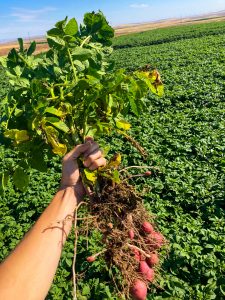
Baby potatoes which will be seeds for next year

From the east coast of Harrison, New York to the hills of Ione, Oregon, a change of perspective was just what Kai Goble wanted as he searched for his 2022 summer internship. Kai spent his summer embracing the unique learning opportunities he was presented with at CSS Farms in Ione, a 600 hundred acre potato farm. Because CSS Farms focuses on producing potatoes, Kai said, “I saw crop production directly of a consumer’s food, opposed to seeing crop production used for fuel or feed.”  

Kai’s summer responsibilities included soil and petiole sampling, a practice performed to show whether or not the roots of the plants are absorbing the nutrients, monitoring plant growth and ground coverage, as well as scouting for weeds, insects, and diseases.  

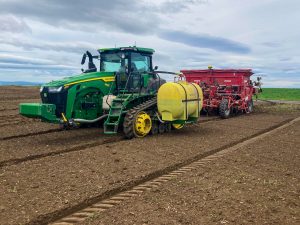
Kai behind the wheel of a tractor planting potatoes in Idaho
Kai planting a field of potatoes in Pasco, Washington

“Working with a new crop allowed me to make connections to things I had learned in class at Iowa State, but it also allowed me to connect the in – class lessons applied to a crop that was not taught in class,” said Kai.  

A different outlook on agriculture provided Kai with challenges and opportunities to grow as a student, professionally and personally. He advises all students to, “look for a unique experience from what you are familiar with to help you truly broaden your views as an agronomist.”  

Region V Soil Judging Contest brought to life by two Agronomy alums

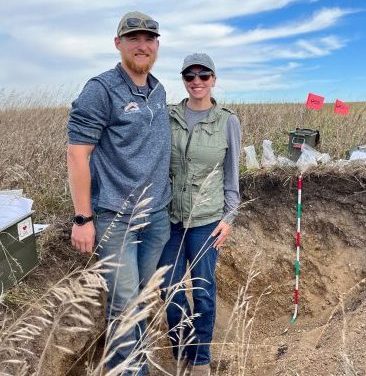
Jacob Schultz and fiancé Trish in one of their pits

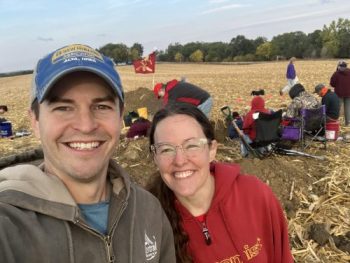
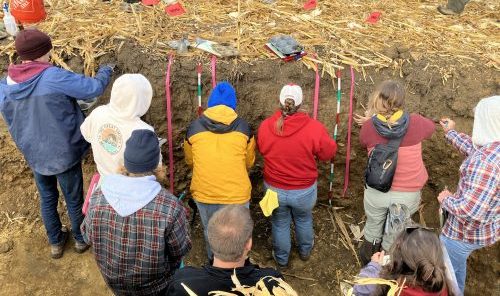
The Region V Soil Judging contest went off without a hitch, thanks in part to two ISU Agronomy alumni. Former soil judgers, Jacob Schultz (BS, 2021) and Nathan Anderson (BS, 2010), opened their farms in Northwest Iowa to 100 college students the first week of October.

Or as they would say “the busiest time on the farm” since their families were in the middle of corn and soybean harvest.  Each farmer also volunteered to dig pits with their own backhoes and labor.  A labor of love to showcase how meaningful their time at ISU and in Agronomy and soil judging was to them.  

The Schultz Farm in Osceola County was the site of 4 practice pits including two that were extremely challenging.

“Soil judging gave me the opportunity to see neat soils in different places, it was fun to come full circle and be able to host this contest,” said Jacob Schultz.

Nathan Anderson with ISU Soil Judging team lead Amber Anderson

The Anderson Farm in Cherokee County was the site of the 5 contest pits.  Additional pits were at the Northwest Iowa Research Farms near Sutherland and Doon (Andrew and Landon) and at Iowa Lakeside Laboratory (Mary Skopec and Matt Fairchild).

“As an agricultural producer, soil judging gave me a unique perspective to understand how soil properties influence crop productivity and yield,” said Nathan Anderson.

Iowa Lakeside Laboratory also served as the host location, providing lodging, meals and meeting space. The 100 students came from 7 universities and three community colleges (University of Nebraska – Lincoln, University of Nebraska – Omaha, University of Minnesota,

University of Missouri, South Dakota State University, Kansas State University, and Iowa State University, Black Hawk Community College (Illinois), Northeast Nebraska Community College and Oklahoma Community College.

The university-winning team was the University of Nebraska-Lincoln (coached by Judith Turk and Becky Young). The ISU team placed 3rd.  Meyer Bohn was the coach. The college-winning team was Black Hawk College, coached by Andrew Larson. The contest was organized by Amber Anderson (Assistant Teaching Professor). She was assisted by Lee Burras (Morrill Professor) and Casey Luke (Undergraduate in Agronomy). Additional questions should be directed to Amber Anderson.

Taking risks: An internship in Idaho creates opportunity

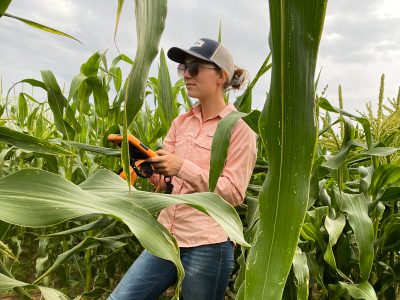
 Elzabeth Tranel scouting in a corn field

Recording, analyzing, photographing, classifying, and traveling were tasks Elizabeth Tranel, junior in Agronomy from Madrid, Iowa, became familiar with this summer while she explored the fields of Caldwell, Idaho. As a Field Production Research Intern for Syngenta Seeds, she developed an array of skills which will benefit her as she continues her studies at Iowa State and future career endeavors.  

Analyzing crop injury data for a sweet corn inbred herbicide trial, photographing and classifying sweet corn rogues, and experiencing travel through pea, green bean, and sweetcorn production fields throughout the Pacific Northwest, enhanced Elizabeth’s perspective on the differences between agriculture in Idaho and the Midwest. 

“From irrigation and soil management practices, to field sizes, crops farmed, and pest and weed management, the people at the Caldwell site did a wonderful job teaching me all about what differentiates Idaho from Iowa farming practices” said Elizabeth.  

Elizabeth’s time this summer in Caldwell was made extra important special working alongside Iowa State Agronomy Alumni, Kirsten Backes. Through connections, Kirsten provided Elizabeth with direction with her long – term career goal of working in research for a larger seed company.  

Moving to a new state for a summer taught Elizabeth the importance of embracing independence, knowledge gained, and opportunities derived from putting yourself in uncomfortable situations.  

“I encourage everyone to take a risk and accept a job somewhere they know nothing about and create opportunities to challenge yourself to continually grow as an agronomist. Once you get settled into the position, take time outside of work to get to know the area and the people to give yourself the best experience possible” Elizabeth emphasized.